
Friday, February 21, 2014


Monday, February 17, 2014
Carnevale Parade of Boats

The Corteo Acqueo di Carnevale, or what I called the Carnevale Parade of Boats above, is organized each year by the Associazioni Remiere di Voga alla Veneta, the association of all the rowing clubs in Venice (including Mestre). It's the central event of the Festa Veneziana at the beginning of Carnevale: the roughly 24 hours of festivities centered in Cannaregio and oriented toward locals, not tourists. Though, of course, the official Carnevale website is sure to invite tourists to the events.
There seems to be slightly more talk this year about neighborhood-centered Venetian-only Carnevale events. Or perhaps there's the same amount of talk but, as Jen suggested when I asked her about it, it's just that there's more of a political edge to the talk: a bit more defiance in the face of all the powers in the city that seem to think only of tourists and how to shove ever more of them through the city in ever shorter amounts of time--like restaurants in New York City who devote themselves to "turning tables" (ie, hustling diners through dinner to increase the number of seatings per evening).
When the paving stones are overrun with tourists, though, there's always the water.... Venetians can get in a boat and go out into the lagoon. Or, on certain special days such as yesterday, reclaim their own "Main Street"--at least temporarily--from the dense traffic that usually makes the experience of rowing down it far from peaceful. (More on that in the next post.)
Excuse me for repeating something I've written before, but Venetians seem never so content--at least relatively speaking--as when they are on the water. It's what makes the Corteo such an enjoyable sight.
Though I was surprised to see that even for the 30 minutes or so that it took the rowers to process from the Punta della Dogana to the Cannaregio Canal the Grand Canal could not be kept free of water taxis, almost every one of them stuffed with a dozen tourists, that snaked one after another along the side of the corteo at all-too-frequent intervals for my taste--and, I imagine, for the taste of the rowers as well, who, as always, had to deal with their wakes.


Saturday, February 15, 2014
In the Wee Small Hours of the Morning...
 |
| This, too, is Venice: waiting for a late-night vaporetto |
...when not only is the whole wide world fast asleep, as the old song says, but the vaporetti are running very infrequently, is the time when you really want to be sure not to get on one going in the wrong direction, as I did early this morning while paying more attention to the book I had with me than anything else.
Wednesday, February 12, 2014
The 10-foot-tall Napoleon Hidden along the Grand Canal
 |
| The rough marble strut connecting the head to the outstretched hand is the only sign that Angelo Pizzi's sculpture of Napoleon was left unfinished at his death. It was commissioned by Lucia's husband, Alvise Mocenigo, who intended to make it a centerpiece of his mainland estate. |
In fact, the "piece of the purest marble of Carrara" Lucia wrote about may be seen in the image at the top of this page, in exactly the almost-completed state it was in when she tried to soft peddle it to her old friend Canova. For by the time she wrote the letter the Austrians had taken over Venice and a heroic ten-foot-high embodiment of her late husband's admiration for the fallen Napoleon was the last thing that the widow, already facing enough personal and financial challenges, needed in her possession.
Unfortunately for her, Canova was well aware of the actual form of the "piece of marble" she was offering him at what she promised would be a "sum agreeable to (him)" and was no more keen to be stuck with the monumentally outmoded thing than she was. So she was left to have it spirited the short distance down the Grand Canal to Palazzo Mocenigo, where she tucked it away in a corner of the androne (or large ground-floor entry).
Though this monumental sculpture's obscure place in the androne of Palazzo Mocenigo figures prominently in di Robilant's explanation of how he came to write the biography, the small image of it in the book shows it against a solid black background. The dark featureless (photoshopped) background certainly eliminates all distractions from the sculpture itself, but part of the interest in di Robilant's opening pages--for him and the reader--is that this work still stands exactly where his great-great-great-great-grandmother set it up 200 years ago, even though the palazzo itself passed out of his family's hands some 70 years ago.
In my post about the heroic sculpture of Napoleon in the Museo Correr (http://veneziablog.blogspot.it/2014/01/empress-sissi-slept-here-what-price.html), I mentioned that a friend had told me that one could catch a glimpse of this work in the androne of the Palazzo Mocenigo on the Grand Canal if one were rowing in a sandolo and took the little boat up close to the water gate. But thanks to the generosity of another friend, Gijs Went, who allowed me to post the above image he captured of the sculpture, we can all have a good look at it in its long-time home, with the stemma (or coat of arms) of the Mocenigos still visible behind it (though the palazzo is now an apartment house)--and without having to struggle with oars or the unsettling wakes of passing vaporetti and mototopi.
Sunday, February 9, 2014
The Best Photography Shop in Venice (Updated 8 June 2018)
 |
| Marco Missiaja's Pro Photo Italia shop on Calle dei Fuseri (address: San Marco 4367) (all images updated 8 June 2018) |
I don't know exactly how many photography shops there are in Venice, but I have no doubt about which of them is my favorite. I first happened into Marco Missiaja's Pro Photo Italia (in its old location) on Calle dei Fuseri in need of a tripod. I later returned for a number of other little things--rechargeable batteries on one day, a memory card on another--and always enjoyed talking to him. A photographer himself, he turned out to be a great source of information (in Italian and English) not only on the subject of gear, but on the practice of taking pictures.
I also appreciated the fact that I could ask him about different lenses I was considering for my camera without ever feeling that his answers were dictated simply by his interest in making a sale. He didn't suggest equipment based upon its cost, nor his profit margin. On the contrary, I've known him to tell me flat out that something I was thinking of buying was not something I actually needed.
 |
 | |
| Marco and his partner, Grazia, behind the counter on Calle dei Fuseri |
When I originally posted this in February 2014, Pro Photo Italia actually consisted of two small shops near either end of the Calle dei Fuseri. A short time ago the contents of those two separate storefronts were combined in a single more spacious shop on the same calle, about midway between where the two small shops used to be and a few yards from the Ponte dei Fuseri.
The greater amount of space in the new location allows not only for the better display of photography supplies, equipment, and framed images, but for workshops and events to be held in-store: either in a light-filled ground floor room or a well-equipped photography studio upstairs (see images below).
I've found Marco's prices to be the best not only in Venice proper, but usually as good as any I've seen on the mainland or online. But you can check this out for yourself by visiting his website and online store at: http://www.prophotoitalia.com/
There's also a second Pro Photo Italia in Rome, run by Marco's brother, which I haven't visited yet, but which I look forward to checking out (its address can be found on the website link above).
But when you're in Venice and in need of photography supplies (however small) or gear (however sophisticated) Pro Photo Italia is the place to go.
 |
| The new shop has space on the ground floor in which to hold workshops and events... |
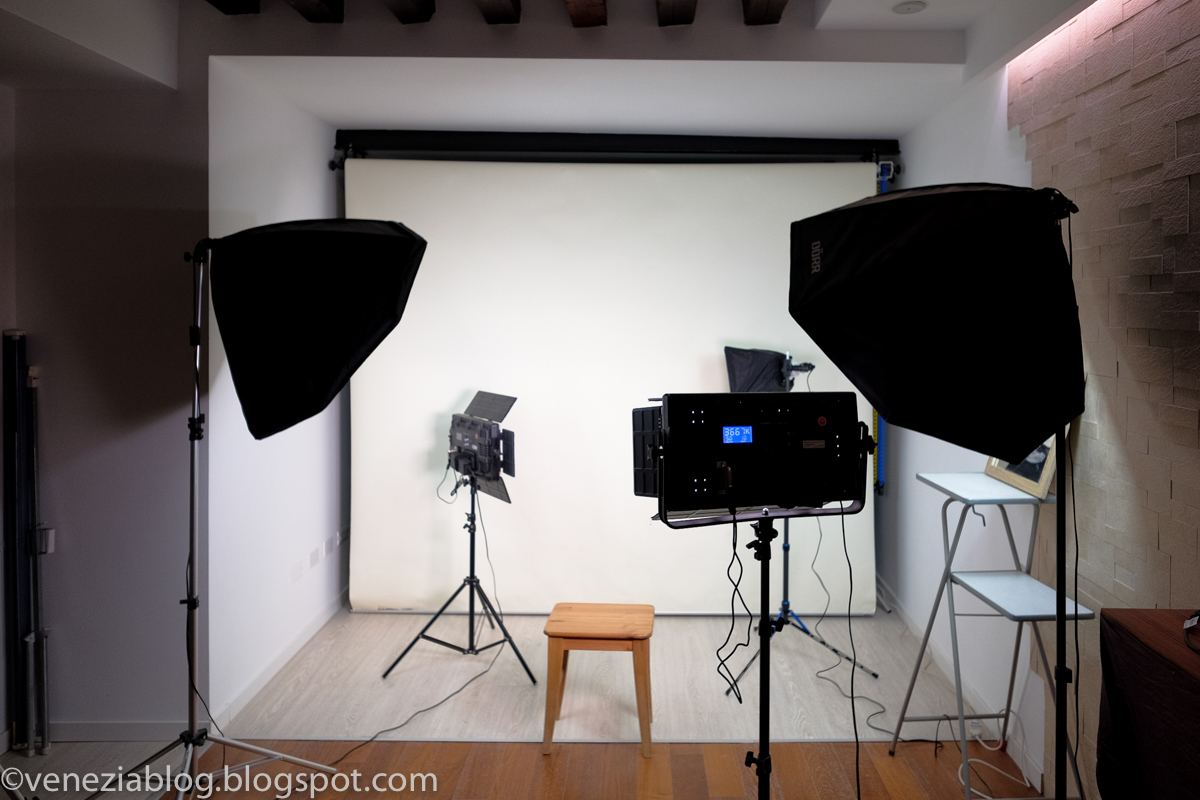 |
| ...as well as a studio upstairs for workshops focusing on matters of lighting and studio photography |
Thursday, February 6, 2014
Long Time No See: Ala Napoleonica, Piazza San Marco

I believe it was less than a month ago that I saw two headlines in a local newspaper about the large billboard covering much of the Ala Napoleonica wing at the western end of Piazza San Marco. The larger of the two announced what everyone in Venice has long known: that work behind it was completed and the scaffolding was (over)due to come down. A second slightly smaller headline a bit further down the page declared that the director of the Museo Correr had suggested that the scaffolding and billboard might remain anyway, as the museum needed the revenue it provided.
The first headline gave me a few moments of hope that after four years of being hidden behind ugly advertisements the western end of the Piazza would finally be uncovered. The second was enough to reaffirm my belief that in spite of vocal and ongoing objections to the billboard by prominent groups and individuals, it would remain forever.
So imagine my surprise when I entered Piazza San Marco this morning and saw the above sight. I imagined at first that they were simply in the process of changing the billboard from one gross garishness to another, but, no, upon closer inspection I found the scaffolding really was being taken down.
Though I've lived here since November 2010, and visited at the beginning of that same year, I hadn't seen the Piazza without the billboard since my prior visit to the city, way back in the early 1990s. Jen and Sandro, having first seen the Piazza during that February 2010 visit and having lived here for over 3 years, had never seen the Piazza without a billboard.
After so many uninterrupted days of rain, the long-awaited reappearance of the sun today seemed almost miraculous--but nothing compared to the reappearance of the western end of the Piazza San Marco from behind its massive billboard. The rain is forecast to be back tomorrow; here's hoping that all billboards in the Piazza are gone for good.
 |
| One can finally see the empty spot at the center of the Napoleon Wing where a statue of the French conqueror was supposed to go |
 |
| A worker lowers a piece of the scaffolding to his colleagues below |
Saturday, February 1, 2014
Water Water Everywhere, This Afternoon & All Week + Vote for Blog Awards
 |
| Piazza San Marco this afternoon after the worst of the tide had receded |
Day after day of the scirocco, of rain, of high water. Photographers and/or many tourists tend to love the last of these, but shop owners really really don't. Tomorrow we'll get a break from the acqua alta: the forecast is for a height of 105 cm, which is still high enough to flood Piazza San Marco, but not nearly so bad as the 120 to 140 cm occurrences of recent days. But there seems to be no end in sight of the rain.
Meanwhile Italy Magazine is currently giving readers the chance to vote online for their 2013 Blogger Awards in a variety of different categories, such as "Best Italian Food Blog", "Best Italian Art & Culture Blog", "Best Italian Fashion & Design" blog and so on.
Venezia Blog is one of four finalists in "Best Living in Italy (Single Post)" category for a piece I wrote on my son Sandro and the practical beauty of handtrucks in Venice. You can read each of the four posts and vote for your favorite here:
http://www.italymagazine.com/blog-awards/2013?field_blog_category_tid=44501
A complete list of the other categories is at the right side of the above page and will give you the chance to check out the other finalists and vote. The last day to vote is February 8.
And I'm pleased to note that the process of casting a vote requires simply a single click of the mouse, with no additional fields to fill out or information to provide or commitment.
NOTE ADDED ON FEBRUARY 4: I just found out that a Venezia Blog post on a little wine shop in Cannaregio is among the finalists in the "Best Single Post Art & Culture" category. I feel rather silly not to have known this before and to add it now, but I'm flattered to be included in the running.
http://www.italymagazine.com/blog-awards/2013?field_blog_category_tid=44504
Subscribe to:
Posts (Atom)