Showing posts with label Palazzi of Venice. Show all posts

Saturday, May 18, 2024

Reflections of Ca' Fornoni in 3 Crops

An old Murano vase in a color I haven't seen much of before: black (but with an almost purplish tinge in person). If I remember correctly I found it in the nice little shop Ambrus Antichità Venezia on Calle dei Cristi off of Campo San Cassian and paid, at most, 40 euro. But that shop also has, among other things, some very fine vintage pieces of Murano glass. It's worth stopping in.


Sunday, May 8, 2022

A Grand Piano Nobile Both More and Less Than It Appears


These images from 2015 are of a piano nobile whose grand appearance was produced by an ingenious combination of authentic historical elements (such as the stucco figures) and clever, skillfully-done simulations, which upon closer inspection, readily revealed--in fact, reveled in--the modest contemporary materials of which they were constructed. 

In foregrounding their stagecraft the creators of the space remained true to John Ruskin's dictum that missing historical elements should not be replaced by modern simulations, whose aim is to fool the unsuspecting into thinking everything they see is the real, historical thing itself--as is the case of the extensively reconstructed facade of the Basilica of San Marco, for example, and in most other famous sites of Venice as well. But in this case they did so with a sense of whimsy (not really discernible in these photos) that Ruskin would never have imagined. 


Tuesday, January 1, 2019

The Stone Menagerie on the Grand Canal


Because there's so much to take in on the vast facade of Ca' Persaro, it's surprisingly easy to overlook the grotesque strand of monumental animal heads running along its base, but here they are to begin the new year, and perhaps it's nice to fantasize that they might serve (as grotesques were once intended to do on facades) to keep evil spirits and malevolent forces at bay over the coming month--not just at Ca' Pesaro, but in Venice and the lagoon as a whole.

In any case, it's no simple to task to discern exactly which animal is supposed to be represented by each face--but that would be a topic for another post, and require a lot more images. 


Wednesday, December 19, 2018

Off the Beaten Track


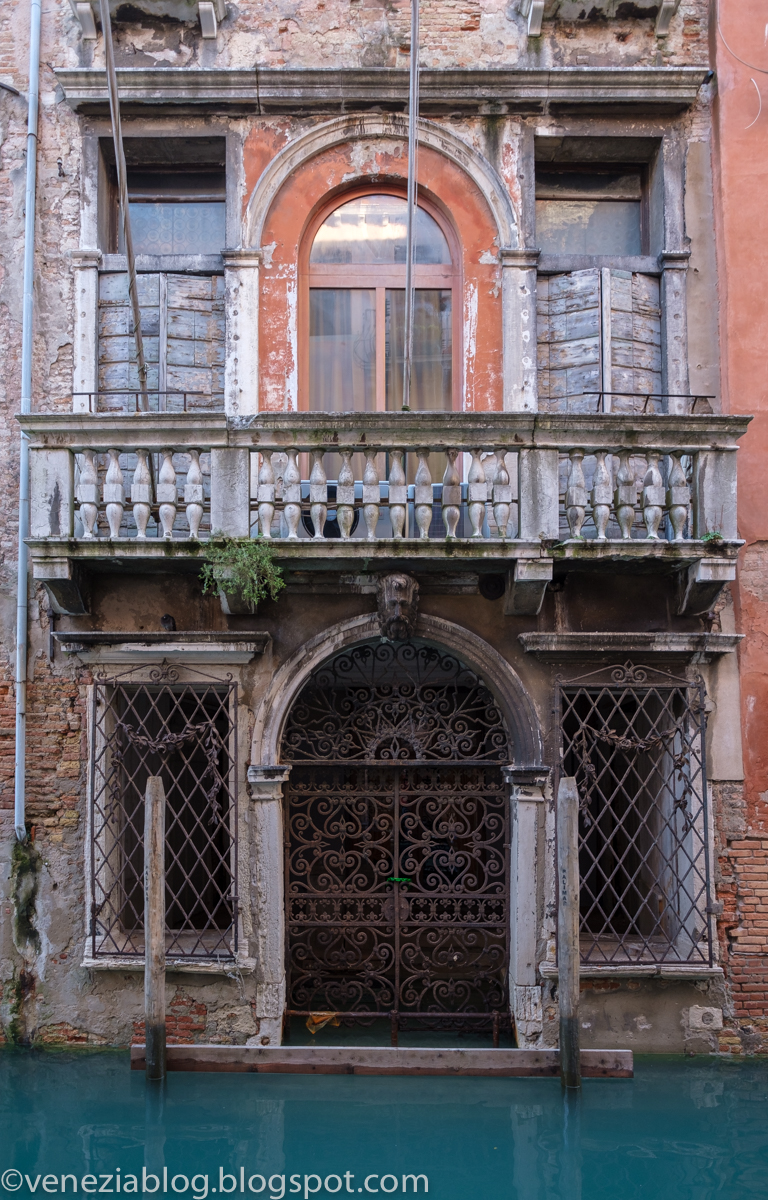
"I've never seen that palazzo," my wife declared when I showed her the two images posted here, and I replied that she never will, unless she comes with our son and I the next time we take a boat ride through certain rii in the historic center.

For this is one of those facades whose splendor--weathered enchantingly by time and tide, and almost impossible to capture, even with a wide angle lens--glimmers upon a narrow high-walled canal, completely out of sight of any foot traffic.

It is quite literally off the beaten track, as that phrase refers to a path pounded smooth by pedestrians, and it's doubtful that anyone's ever been able to stump past this facade.  

I think there is a gondola route that passes by this place but, based upon years of casual observation, it seems a good many passengers on gondole would be too absorbed in taking selfies to notice it, as the narrowness of the canal means that even motoring or rowing at the slowest rate you come upon it suddenly--and just as suddenly it's out of sight. You really need to be watching for it.

To get even these two images required the aid of a skilled 10-year-old boat driver, who kept our sandolo-sanpierota idling in place against the wall opposite this facade, while I stood upon the highest point of our low boat, stretched the camera as far above my head as I could reach (to minimize converging vertical lines) and snapped.

Whenever I think of posting an image like this, one visible only from a boat, I think of those who will take it as evidence of the need for kayak rentals or kayak tours in the historic center, so that such views can be open to everyone.

But whoever said that every part of any city--even every public part of every city--should be readily available to all?

After all, it's not like Venice is lacking for sights readily seen on foot, is it?

In his preface to A Portrait of a Lady, which he completed while staying in a pensione on the Riva degli Schiavoni, Henry James wrote how the sight of Venice outside his window was always calling him away from his work: that Venice was one of those places that simply refused to remain merely background.

But James was writing this preface over 100 years ago, and recalling a period of composition from two decades before that. Much has changed: the selfie stick--and the mindset from which it sprang, and which it now exacerbates--can reduce even a Leonardo or Michelangelo to stage set or prop.


It's too bad, as it really is hard to go anywhere in Venice without finding some place or scene more than worthy of attention. The city bristles with what James would have called subjects: they fall at your feet, they fall into your lap, they fall upon you hard like hail. Or maybe that's the way to describe objects of attention.

Subjects perhaps, in contrast, don't so much fall upon you, passively, as call upon you. They assert themselves, demanding your attention, overwhelming your own sense of self, interfering with your plans and whatever sense of purpose you might have had the minute before. And nowhere, James suggested, do they do this more frequently or thickly than in Venice. They're everywhere.

So, as much as I marvel at these off-the-beaten-track water doors, I don't post them to suggest that people who've never seen them are missing something, as missing something--actually, missing a countless number of somethings--is also, inevitably, part of the Venice experience, whether on land or water, and even for the most attentive of visitors, or residents. The interesting question, in the midst of such overwhelming sensory abundance, is not of what one's missing, but of what manages to stick--and, luckily, contrary to the suggestions of guide books and tour guides, there's no predicting that for each person.
  

Saturday, March 31, 2018

Unseen Venice: Rainy Day Noir, This Afternoon


Both the wrought iron railing of the stairway in the images above and below and the mosaic floor design in the image above are said to have been installed in 1932. This stairwell space was likely to have been an open cortile for most of the many decades following the construction of this palazzo in the 16th century, with the apartments now served by it being accessed instead through neighboring palazzi (or possibly, in the earliest years after the building's construction, by an exterior staircase). 

At the some point it seems likely that a floor or two were added to the top of this building, as was common: I lived for a time in a top floor apartment in Dorsoduro which was part of two floors constructed atop a 14th century palazzo after World War II.

Outside the entrance to the apartment house pictured above and below is one of the last remaining 12th century arcades in the city--its columns looking quite squat as a result of the paving stones having been raised around them time and again over the years to deal with subsidence, and its open spaces bricked up to form walls--but still intact.

All of which is to say that in this compact city one is always traveling much further in time than space, traversing centuries with just a few steps. 


Friday, March 3, 2017

Unseen Venice: Three Frescoes By Pietro Antonio Novelli


This series of three large wall freschi in the single room of a private residence by the the Venetian painter Pietro Antonio Novelli (1729-1804) suggests the Carnevale just concluded and the warmer weather to come.


Saturday, June 13, 2015

The Union of Fire and Water--and of Venice and Baku, Azerbaijan--at Ca' Barbaro

The entrance hall of Ca' Barbaro, with video by Almagul Menlibayeva on right wall
The exhibition entitled The Union of Fire and Water by the two Azerbaijani artists Almagul Menlibayeva and Rashad Alakbarov, which now fills most of Ca' Barbaro's piano nobile (and continues until November 22), manages to tell a story with the far-ranging sweep and drama and pathos of the best of historical novels.

Taking as their starting point the fact that the Venetian ambassador Giosafat Barbaro (1413-1494) "traveled to and wrote extensively on Azerbaijani cities and the court of Shah Uzun Hassan" (from exhibition's press release), the artists position Venice and the city of Baku as the two poles of an extensive series of cross-cultural exchanges, and conflicts, stretching from the 15th century to the 20th, when the oil magnate Murtuza Mukhtarov built a grand Venetian Gothic style palace in Baku for his beloved wife.

Having served various functions since its construction in 1912, the palace now houses the main marriage registry office in Baku, according to the press release, and is known as the "Palace of Happiness". Though the romantic tale of Mukhtarov and his wife did not itself have a happy ending. Just eight years after the palace's completion, Mukhtarov commited suicide after fighting against (and killing some of) the invading Bolshevik forces.

The Union of Fire and Water is an ambitious and interesting exhibition that manages to more than hold its own within storied rooms once frequented by Henry James, Robert Browning, Monet, Whistler, and John Singer Sargent. 

Much more information on the exhibition and artists can be found here: http://www.bakuvenice2015.com/

For those interested in an intimate (and pocket-sized but very nicely produced) introduction to Ca' Barbaro itself during the years when Henry James stayed there, I'd recommend Letters from the Palazzo Barbaro (Pushkin Press), which includes not only letters written by James himself, but is rounded out with letters from members of the Curtis family that provide interesting glimpses of their celebrated guest.

A previous post on a prior visit to Ca' Barbaro--when the palace's rooms were filled not with new art, but with the furniture of the present owners, and which includes images of the palace's courtyard made famous by its appearance in the BBC Brideshead Revisited--can be found here: http://veneziablog.blogspot.it/2013/03/a-visit-to-ca-barbaro_27.html

A final note: The famous high-ceilinged salone depicted by John Singer Sargent in his portrait of the Curtises (an image of which is included in the earlier post above) is, unfortunately, not open to the public during the present exhibition. Though there is a link in the post above to a website with images of the salone.

The grand central hall or portego with a weathered metal house of cards sculpture by Rashad Alakbarov, Precariousness of History, that introduces a central theme of the exhibition. (Also of note, a large ceramic stove near rear windows: a heating source that WD Howells, writing in the 1860s, describes as being generally unheard of in Venice palaces.)
Stucco work above a door of the portego with satyr-cherubs
Rashad Alakbarov's stairway maze, Untitled (Omnes Viae Ducunt Venetias)
Alakbarov's installation Do Not Fear
A detail of a stucco ceiling
Stucco work above a door
A detail of a stucco ceiling
An Alakbarov installation with mirrors (with "I WAS HERE" reflected on wall at rear) in the palazzo's dining room
A detail from the dining room ceiling
An Almagul Menlibayeva video installation in which a sea appears to surge just outside the palazzo's windows (in another room, another pair of "video windows" create the illusion that the city of Baku itself lies outside the palazzo)
A detail of Menlibayeva's and Alakbarov's melancholy installation Conclusion

Thursday, May 28, 2015

Monochromes in a Palazzo with a Colorful Past: Dansaekhwa at Palazzo Contarini Polignac

A large stucco ceiling in one of the palazzo's stairwells
Sometimes it seems that one of the biggest challenges for art works displayed in what are called the "official Collateral Events" of the Venice Biennale is not to be dwarfed by their grand surroundings--palazzi and the like--and their long history. And I'll admit that what draws me to certain exhibitions are, in fact, the places (and palaces) that host them--otherwise closed to the public--rather than the art itself.  

One such official Collateral Event worth a visit for both the art and the site is Dansaekhwa at the Palazzo Contarini Polignac (also know as the Palazzo Contarini dal Zaffo) in Dorsoduro, just a short distance from the Accademia Bridge. Dansaekhwa, an important movement in post-war Korea, is the term applied to a school of abstract painting with a limited color palette and, in many cases, a strong relationship with traditional Taoist and Buddhist ideas. The exhibition is notable for the accessible way in which it situates the art in both Eastern and Western cultural contexts with an interesting documentary that loops in one salon off the largest of the exhibition rooms.

A good overview of the exhibition, its artists, and their works on display can be found here: http://www.arte.it/art-calendar/venice/exhibition-dansaekhwa-15217

Because of much of the art's subtlety of color and the importance of texture and scale to it, I saw little point in trying to photograph it for this blog. As far as pictures went, I focused on the palazzo itself, which, as it turns out, happens to feature some monochromatic pieces of its own on its ceilings, dating from a good two hundred or more years before the works it hosts.

The palazzo is now most famous as the former home of Winnaretta Singer (who became known as the Princess de Polignac), an heiress of the Singer sewing machine fortune, and the host (usually in her celebrated Paris salon) and patron of some of the most important composers of the late 19th and early 20th centuries: Debussy, Fauré, Ravel, Poulenc, Satie, and Stravinsky among them. A short distance down the Grand Canal, another heiress and patron of the arts, Peggy Guggenheim, would later set up shop in her own palazzo and become known as a major patron of 20th-century visual arts, but I can imagine some people arguing that Singer's influence in the field of music was in fact even more extensive--if less generally known these days.

And Singer's unconventional life itself (as something of a sexual outlaw) was hardly less interesting than her taste in music (http://en.wikipedia.org/wiki/Winnaretta_Singer#Patron_of_arts).

A view out of this palazzo's ornate wrought iron water gate onto the Grand Canal was the subject of a previous post, here: http://veneziablog.blogspot.it/2015/05/looking-out-front-door-of-palazzo.html

Palazzo Contarini-Polignac, aka Palazzo Contarini dal Zaffo, with its pretty loggia overlooking a private garden


One of the palazzo's ceilings featuring a monochromatic mythological scene
A detail of the same scene
A second of the palazzo's mythological monochromatic ceiling scenes
A detail of the same scene
A detail of a large monochromatic grid painting by Chung Sang-Hwa: Untitled 75-8-12, 1975
A portrait of Richard Wagner in pastel (and behind glass) in a dark corner of the entry to the piano nobile serves as evidence of the famous musical patron who once lived in the palazzo (and used to frequent Bayreuth)
This bust standing sentry in a niche beside the palazzo's elevator (perhaps a young Contarini?) attests to more distant inhabitants
This small exterior courtyard is the closest one can come to either the loggia (visible at top) or the private garden lying behind the green door at right

Sunday, March 9, 2014

Dora Maar, and Much More, at Palazzo Fortuny

Prominent among the other works of Mariano Fortuny in this image is one of his famous classically-inspired gowns, while two glass pieces by contemporary artist Ritsue Mishima are visible on the large table at left
Yesterday, March 8, marked the public opening of the spring exhibitions in Palazzo Fortuny: chief among them an extensive show of photographs by Dora Maar, an artist in her own right, though, as the title of the exhibition--Nanostante Picasso or In Spite of Picasso--suggests, still often better known as a model and muse for others. (One of Picasso's famous portraits of her is among the many pieces on display, and another by Man Ray). Also newly on view is Le ammazzoni della fotografia: a selection of photographs from the collection of Mario Trevisan, ranging from the 19th-century work of Juliet Margaret Cameron, through Dianne Arbus, to the unsettling child portraiture of contemporary German artist Loretta Lux; and other exhibitions of works by Ritsue Mishima, Anna-Karin Furunes, and Barbara Paganin. A complete description of the currents shows, which run until the middle of July, may be seen (in English or Italian) at: http://fortuny.visitmuve.it/

I had the good fortune to attend the preview of the spring shows on Friday, the first time, I'm rather embarrassed to say, I've actually visited Palazzo Fortuny--a couple of previous intended visits went awry. I did so in spite of a bit of a fever and some kind of virus that still hasn't gone away, and that has for the most part deprived me of the ability to put one sentence after another in any coherent fashion. So I'll leave this post mostly to some dozen photos, some captions, and the encouragement not to wait so long to visit Palazzo Fortuny as I did. It's one of the truly singular interiors of Venice, and still infused with the spirit of the painter, sculptor, photographer, designer of textiles, stage sets, fashion, and lighting who created it all.  

In the foreground is Sante Benato's and/or Giovanni Gloria's immense model of Villa Pisani in Stra, constructed around 1716
Léonor Fini allongée sur un planché jonché vetements by Dora Maar, from 1936
Portrait de Dora Maar de trois quarts ou fume-cigarette by Izis (Israel Bidermanas) from 1946
Some contemporary women take in the images of anonymous women of the past that make up the exhibition Shadows by artist Anne-Karin Furunes
Another work in glass by Ritsue Mishima amid various works by Fortuny
Fortuny's large model of the Bayreuth Theater, constructed in 1903
Another of Fortuny's stage designs, from 1908
Above and below: the frescoed walls of the room which now holds Fortuny's theatrical models and scenic studies

An anonymous death mask of Beethoven