Monday, October 17, 2011

Rowing in the Venetian Style

 The calm before the struggle: the caorlina of my first rowing experience
photo credit: Nicola Capuzzo


Yesterday morning I made my second try at rowing Venetian style, standing up, facing forward, with an oar that's longer than the average New York City studio apartment is wide.

After the first attempt, made one week before yesterday, I was convinced I would have made a terrible galley slave. It's not a position one associates with a lot of job-training, but rowing in time with others is much harder than it looks in those old Hollywood biblical epics.

The first challenge a novice faces is getting the hang of the particular wrist movement needed to position the oar correctly: that is, horizontal to (and out of) the water as you move it into the forward position, then vertical to (and in) the water as you push into the stroke.

Well, actually, let me back up. The first challenge a novice faces is stepping into--and staying inside--the boat. The first boat I went out in was a caorlina (a rather large and heavy boat with places for six rowers, as used in the regatta storica) and I was told to step only on the thin ribs that spanned its bottom, not on the broad inviting and much more stable open spaces between the ribs. I didn't ask why, I was too busy trying not to fall out. But it's a comfort to the novice to see that even expert rowers move quite gingerly aboard the boats. In fact, even the two cats belonging to the remiera, or rowing club, moved very carefully around the neighboring boat they were exploring.

In any case, once you're in the boat, and have properly positioned your very own forcola (or carved oarlock) in its designated opening in the side of the boat by hammering little wedges of wood around it, you must concern yourself with that wrist rolling I mentioned. Just before pushing forward with the roughly 12-foot-long oar into each stroke you must roll both wrists back as you would roll just your right wrist if you were riding a motorcycle and wanted to increase its speed. You must also dip the oar into the water. The latter action is of course obvious. But that doesn't mean it's easy. Especially when the lagoon is wavy in the wake of one infernal vaporetto after another and the surface of the water, or the boat's position on it, is no longer where it's supposed to be.

The Remiera Francescana is located near the Celestia vaporetto stop within the Arsenale, and after a bit of warming up in one of that massive old structure's placid basins, we headed out into the lagoon in the direction of Murano. I recalled noticing on my way to the remiera what a beautiful early morning it was, with the Dolomiti clear and brilliant beyond the western edge of the lagoon, but once I was in the boat I might as well have been rowing inside a small dark barn. My eyes were fixed on the end of my oar, to be certain it was how and where it was supposed to be at every moment. In fact I was supposed to be watching my friend just ahead of me, at the front of the boat, and rowing in time with her. Almost impossible, no matter how I tried to utilize peripheral vision. I considered it a great triumph to be rowing at all.

Something like a pupparino
I had the distinct suspicion by the time we reached Murano that I had contributed very little in the way of actually propelling us toward that destination, but that didn't stop me from feeling a certain pride when we tied up the craft beneath curious tourists' eyes and popped into a cafe for a quick espresso. Once on land no one can tell what a drag you may have been in the water, and my co-rowers were much too encouraging and polite to mention it.

Yesterday, however, I was much better. And the conditions were much worse. Initially, my improvement seemed to make up for the high winds and rough water, but as I tired Nature (as it or she always will) got the upper hand.

Yesterday I went out with just three others--two experienced rowers and one novice like myself--in a pupparino. "Pupparino!" my fellow (but more knowledgeable) novice rather anxiously exclaimed when our instructor told us what boat we'd be on. A pupparino, I learned, is a smaller, lighter, shallow-hulled boat, in which the possibility of capsizing seems to come into play much more than it does in a caorlina. Imagine a dry leaf tossed upon a rough-running river and that was a little like our pupparino yesterday. 

Rowing into a strong head-wind, on a lagoon just barely lacking whitecaps, we got nowhere near Murano yesterday. But the issues with hand and oar position that obsessed me my first time out vanished--to be replaced by others involving leg position. Yet it was, nevertheless, infinitely easier. I was at the very front of the boat and was able to get into what seemed to be a regular rhythm. And when I switched positions with the woman behind, I was even able to follow her movements rather than being obsessed with the end of my oar.

And there, all around us, was the Venetian lagoon! There, beside us, was the cemetery island! And then, thankfully, there, right there, at last, after our strenuous jaunt, a venerable archway of the once mighty Arsenale welcoming us back! Which, I must admit--the water all wild with wind and waves and the wake of a water taxi--we actually crashed into just a bit before passing safely inside.

But neither boat nor arch were damaged, everyone remained standing and dry, and it was probably the first assault upon those old walls in many years. Sore as my muscles are today, I can't wait to get out on the water for a third time. After two outings as a guest, I've decided to sign up as a member of the remiera and, amazingly enough, I think they'll actually let me.

Friday, October 7, 2011

Venice Biennale: Ukraine Pavilion Part 2 (San Fantin)

A dark rainy day like today was the perfect time to see Oksana Mas's work in the beautiful (and usually closed) church of San Fantin.

You can read about and see images of other parts of Mas's massive work (including close-ups of the 1,000s of wood eggs that make up the works), as displayed at San Stae, here: http://veneziablog.blogspot.com/2011/06/venice-biennale-ukraine-pavilion.html

Monday, October 3, 2011

Chiesa San Martino Tonight, 8:45 pm


In the course of trying to take this picture I realized how oppressively well-lit parts of Venice are: high-powered floods, even a surveillance camera or two. Perhaps it's just because this area is around the Arsenale with its active military presence, but it's no longer the gloomy Venice of Donald Sutherland's and Julie Christie's Don't Look Now. At least not in this campiello.

Sunday, September 25, 2011

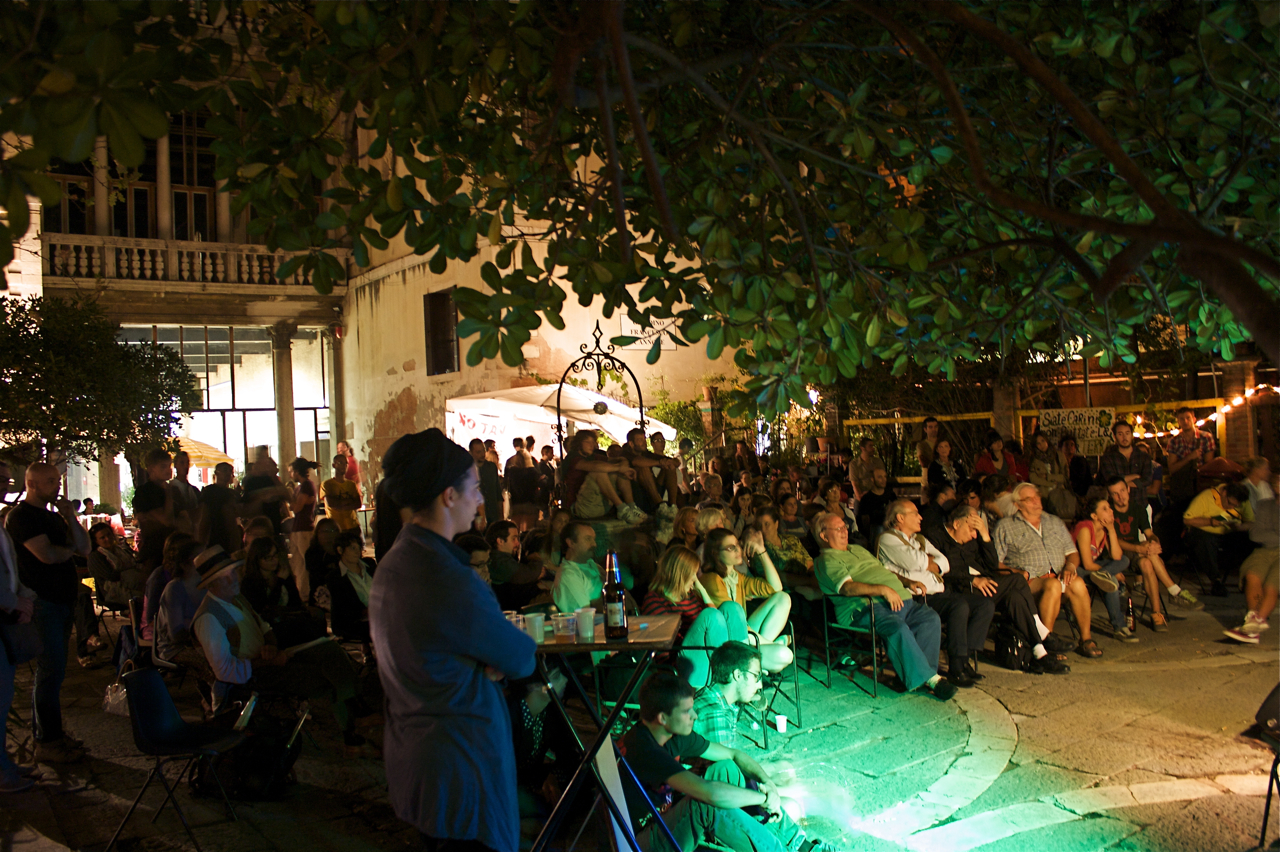
Poetry Slam at Ca' Tron

Gigi reads. Off to his right, the panel of 5 judges; to his left, the poets' score sheet.
I thought I was going to see the American poet Michael McClure read last night as part of the international event 100 Thousand Poets for Change at Ca' Tron, near San Stae. (A few of the 99,999 other poets were also on the bill, but the rest were spread out at different venues around the globe). Information for the event that I'd found online said the event would begin at 9 pm.

Actually, it began at 5 and, from a report I got from a friend, was packed. I didn't know this when I arrived, nor even as I enjoyed a poetry competition among local poets of all ages, which I imagined were the opening acts for McClure. Until the competition wrapped up,  a young raggae band set up on the stage, and I ran into my friend.

Have I ever mentioned how challenging it can be to get accurate scheduling information in Venice? Even for natives. For example, no one with kids in my son's preschool--not even the typically in-the-know-head-of-the-PTA types--knew exactly when the first day of school would be. We had a general idea, but didn't find out for sure (well, almost for sure; few things here are for sure) until two days before school opened. Only the day before it opened did we get some idea of what the actual hours of the first two days of school were likely to be. Though those were inevitably revised on the opening day itself.

In any case, I missed McClure. But if you ever have the chance to catch a poetry competition at Ca' Tron, which is the seat of the Università IUAV di Venezia (an architecture, urban design and arts school), it's worth a visit, even if your Italian is limited, just to take in the scene. They also host films and other events open to the general public.

Refreshment tent and Ca' Tron behind a good crowd
Last night's competition was won by Gigi, an older poet who uses dialect in his works. Though he's often in Venice for business, he told me as we caught a ride home together on the vaporetto, he lives on the mainland, in the countryside. He grew up in the mountains, near Belluno, and though the language he grew up speaking would be considered part of the Venet language spoken throughout the old Venetian Republic, he told me about the differences between his native tongue and that spoken in the lagoon. He also reminded me that such differences between mainland and lagoon were hardly surprising when one considers the differences in language spoken even to this day by natives of, for example, the Giudecca compared to those of Castello, of Castello to Chioggia, of Chioggia to Malamuoco....

In light of which the complexities or ambiguities or multiplicities of scheduling seem to pale.

Electric poet: Rudi, one of the night's three finalists

Thursday, September 22, 2011

Venice Biennale: Arsenale Fuel Tanks

There's no end of competition for the contemporary artist in Venice. As good as the works are in the Chinese Pavilion, I couldn't help becoming obsessed with the huge old fuel tanks lining the walls of the massive warehouse.

A little like the work of some contemporary of the young Rauschenberg & Jasper Johns

Time's incidental beauty

Yang Maoyuan's piece, All Things Are Visible, is visible on the floor