
Wednesday, January 9, 2019


Sunday, January 6, 2019
Witch- and Watercraft on the Grand Canal, This Morning
 |
| One of the most interesting boats on the water today was this gondola constructed of fruit crates that any customer of the Rialto Market will recognize (and anyone who stays in Venice for any longer than a few hours really should be a customer of the Rialto's produce or fish stands) |
The Reale Società Canottieri Bucintoro celebrated today's Feast of the Epiphany with the 41st edition of its Regata de le Befane, featuring, as usual, five of its members dressed in the gear of the holiday witch who delivers sweets to the stockings of good children and coal to the bad.
It's nowhere near as long a race as the Regata Storica, nowhere near as big a production, and nowhere near as fiercely competitive, but the good feelings it inevitably conjures up among the crowds observing it from the Rialto Bridge and the Riva del Vin each January 6 make it an event worth attending.
Images of last year's race are here: https://veneziablog.blogspot.com/2018/01/witches-on-grand-canal-today-regata.html
 |
| After holding off early challenges... |
 |
| the regata's pink-shawled winner led from start to finish |
 |
| The second, third and fourth place finishers acknowledge the cheers of viewers along the Riva del Vin... |
 |
| followed by the winner of the regata with her/his bandiera rossa |
Tuesday, January 1, 2019
The Stone Menagerie on the Grand Canal

Because there's so much to take in on the vast facade of Ca' Persaro, it's surprisingly easy to overlook the grotesque strand of monumental animal heads running along its base, but here they are to begin the new year, and perhaps it's nice to fantasize that they might serve (as grotesques were once intended to do on facades) to keep evil spirits and malevolent forces at bay over the coming month--not just at Ca' Pesaro, but in Venice and the lagoon as a whole.
In any case, it's no simple to task to discern exactly which animal is supposed to be represented by each face--but that would be a topic for another post, and require a lot more images.

Tuesday, December 25, 2018


All Is Calm, All Is White: This Morning

A rower takes advantage of the holiday, and the interrupted vaporetto service caused by the fog, to have the Grand Canal almost entirely to himself this morning.
Sunday, December 23, 2018
A Seasonal Chill--and A Forgotten Cinematic Evocation of Venice in Winter

I was admiring the lighted balcony of a palazzo and its reflection in Rio San Servero last night, not a soul in sight, when the red coated figure in the image above appeared on the bridge of Calle di Mezzo, just down the canal from Palazzo Grimani (its lighted windows and Italian flag visible in the background). Those familiar with Nicolas Roeg's unsettling Venice 1973 film Don't Look Now, in whose climax this same calle and palazzo figure prominently, will not be surprised to learn that I made sure not to follow her.
For those who haven't watched the film--well, in spite of the central role played by a red cloak in the plot, it's not a Christmas movie, but worth watching anyway for its setting of a grimy workaday Venice that's markedly different from the spiffy one we're used to today.
Another less-known film from the same era, which shows even more of the still-living city than Roeg's, is the 1970 melodrama Anonimo Veneziano (The Anonymous Venetian), directed by Enrico Maria Salerno. It's not a great, nor even a good movie: it's maudlin in the same way that I imagine another film released in 1970 must be: Love Story.

But the real love story in Anonimo Veneziano takes place between the film's cinematographer and the city itself. Like Roeg's film, this one is also a winter's tale, set in the off-season Venice of Venetians (back in the day when there still was one and still were some, respectively) and the unhappy pair of lovers go everywhere in the city, and in every possible way: on foot, on vaporetto, traghetto, and in gondola.
You don't need to know a word of Italian to watch this film, as it's not the words that make it worth watching. The two leads are photogenic and may even be fine actors (I didn't notice), and they certainly model the era's fashions marvelously, but their real function is to serve as what Michelangelo Antonioni called "moving space."* That is--in a reversal of the usual relationship between a film's stars and its setting--to occupy the foreground in a way that sets off the background to its best advantage.
For any lover of Venice I'm tempted to say this film, unremarkable as it may be as a film, is something of a must-see (though I've never seen it included in any list of Venice films to watch). And those who have access to RAI Play online** can watch it for free: https://www.raiplay.it/video/2017/11/Anonimo-Veneziano-cc2fb89f-6184-4786-90f6-70389e00fada.html
(A google search turned up an informative Youtube video of some of the locations of the film. Though, as there's a certain pleasure in trying to recognize the many locations--both exterior and interior--as one watches the film, to watch this 8 minute video before watching the film may be like looking at the answers to a crossword puzzle in advance of doing it.)

NOTES:
*According to Jack Nicholson, who starred in Antonioni's 1975 film The Passenger, Antonioni responded to the actor's questions about his own performance by assuring him that it was fine, before admitting that "for me, the actor is a moving space."
**In Italy one can sign up for RAI Play free of charge, gaining access to a vast array of streaming programs and films. I don't, however, know of its availability in other countries.
Wednesday, December 19, 2018
Off the Beaten Track
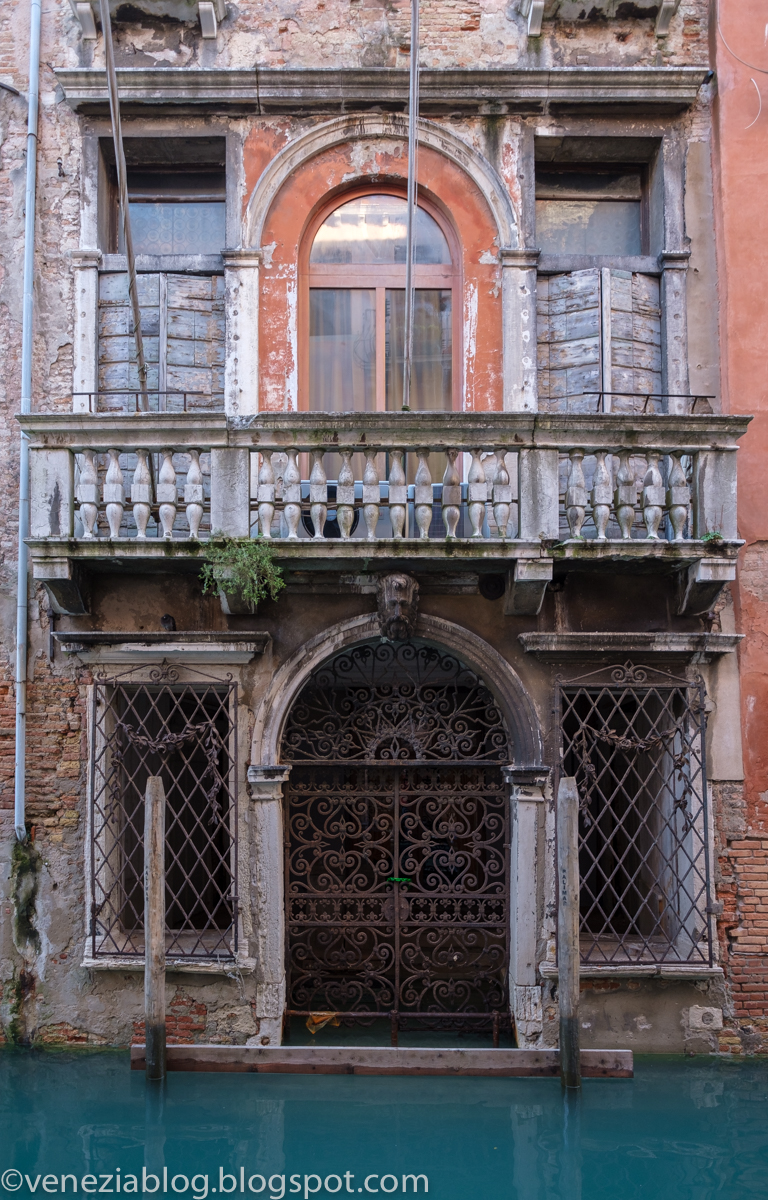
"I've never seen that palazzo," my wife declared when I showed her the two images posted here, and I replied that she never will, unless she comes with our son and I the next time we take a boat ride through certain rii in the historic center.
For this is one of those facades whose splendor--weathered enchantingly by time and tide, and almost impossible to capture, even with a wide angle lens--glimmers upon a narrow high-walled canal, completely out of sight of any foot traffic.
It is quite literally off the beaten track, as that phrase refers to a path pounded smooth by pedestrians, and it's doubtful that anyone's ever been able to stump past this facade.
I think there is a gondola route that passes by this place but, based upon years of casual observation, it seems a good many passengers on gondole would be too absorbed in taking selfies to notice it, as the narrowness of the canal means that even motoring or rowing at the slowest rate you come upon it suddenly--and just as suddenly it's out of sight. You really need to be watching for it.
To get even these two images required the aid of a skilled 10-year-old boat driver, who kept our sandolo-sanpierota idling in place against the wall opposite this facade, while I stood upon the highest point of our low boat, stretched the camera as far above my head as I could reach (to minimize converging vertical lines) and snapped.
Whenever I think of posting an image like this, one visible only from a boat, I think of those who will take it as evidence of the need for kayak rentals or kayak tours in the historic center, so that such views can be open to everyone.
But whoever said that every part of any city--even every public part of every city--should be readily available to all?
After all, it's not like Venice is lacking for sights readily seen on foot, is it?
In his preface to A Portrait of a Lady, which he completed while staying in a pensione on the Riva degli Schiavoni, Henry James wrote how the sight of Venice outside his window was always calling him away from his work: that Venice was one of those places that simply refused to remain merely background.
But James was writing this preface over 100 years ago, and recalling a period of composition from two decades before that. Much has changed: the selfie stick--and the mindset from which it sprang, and which it now exacerbates--can reduce even a Leonardo or Michelangelo to stage set or prop.

It's too bad, as it really is hard to go anywhere in Venice without finding some place or scene more than worthy of attention. The city bristles with what James would have called subjects: they fall at your feet, they fall into your lap, they fall upon you hard like hail. Or maybe that's the way to describe objects of attention.
Subjects perhaps, in contrast, don't so much fall upon you, passively, as call upon you. They assert themselves, demanding your attention, overwhelming your own sense of self, interfering with your plans and whatever sense of purpose you might have had the minute before. And nowhere, James suggested, do they do this more frequently or thickly than in Venice. They're everywhere.
So, as much as I marvel at these off-the-beaten-track water doors, I don't post them to suggest that people who've never seen them are missing something, as missing something--actually, missing a countless number of somethings--is also, inevitably, part of the Venice experience, whether on land or water, and even for the most attentive of visitors, or residents. The interesting question, in the midst of such overwhelming sensory abundance, is not of what one's missing, but of what manages to stick--and, luckily, contrary to the suggestions of guide books and tour guides, there's no predicting that for each person.
Subscribe to:
Posts (Atom)