Tuesday, January 8, 2013

Venetian Sayings: "gransi in scarsea"


As I've been reminded more than once since moving to Italy, people from Genova (or Genoa) are infamous throughout the country for being tight-fisted, even miserly. I need only identify myself as half-Genovese to, say, a shopkeeper with whom I've been having a friendly talk and the odds instantly become about 1 in 4 that he'll remark upon this widespread reputation or, at the very least, with a knowing smile on his face, turn both hands upward, close them, and draw them in tight to his solar plexus in the standard gesture for stinginess.

I'm used to this reaction by now, and find it far less troubling than the response Jen reported that she received from a group of retired Venetians last summer at the beach on Lido when, in the course of a pleasant conversation, she told them her husband was half-Sicilian.

"Ah," one of them replied in Italian, half-seriously, "he's a mulatto."

Of course the Venetians themselves have their own reputation around Italy, and aren't entirely free from the taint of avarice themselves, nor even of tight-fistedness. A Venetian friend recently told me that when referring to such a person, Venetians say that he has a "gransi in scarsea", or "a crab in his pocket."

I assume in Italian the phrase would be "granchio in tascha," but my 20-something friend had heard it only in Venetian.  

In fact, I've met no Venetian to whom I could apply this phrase, nor, for that matter, any family or friends from Genova. It does perfectly describe certain of my immediate relatives in California, but that's another topic altogether, and much better avoided.

Friday, January 4, 2013

Two Lagoons, This Afternoon


I went out rowing a mascareta this afternoon by myself with a single oar, in the open expanse of shallow water north of the Celestia vaporetto stop, between the cemetery island of San Michele and the large barena which, if you're on one of the giro città vaporetto lines, lies closest to you around the Bacini stop. Some days, when the tide is high, this barena--as barene are, by definition, prone to do--disappears almost completely beneath the water. Other days, like today, when it seems like an island all its own, one wonders why the ancient Venetians never chose to build it up and inhabit it.

On the last afternoon of 2012, when I was rowing in the same area, the water was so shallow as to force me to alter both my grip on the remo, or oar, and my rowing motion. It was less than a foot deep, and as I rowed I kept expecting it to deepen at some point, but it didn't. There was not another person visible on the lagoon--no work boats, no motor boats--just the vaporetti running along the north side of the city in the distance, and at one point I wondered how I'd get back to my remiera, or rowing club, if I made the mistake of leaning too heavily and too deeply into a stroke and snapped my oar off on the shallow bottom. I had no cell phone, and perhaps I was far enough out in the middle of the lagoon that no one on a passing vaporetto would notice me stranded out there, no matter how I waved my arms.

As I'm sometimes prone to anxiety, this is the kind of thing I like to worry myself with.

Of course, the simple fact was that, shallow as the water was, I could probably just have walked--or slogged--back to the remiera. At least until I reached the deep water of the Canale delle Fondamente Nove that runs right past it.

But perhaps it was somehow perversely more fun to imagine a greater danger. It elevated my heart rate, which is what a workout is supposed to do, right?

In any case, this afternoon, on my first row of this new year, I noticed something I was struck by on that last row of 2012: how one's row out in the direction of Burano almost seems to be done on an entirely different lagoon than one's row back in. The whole world, as you can see in the photo at top, is a symphony of blue as you make your way north at about 4:00 in the afternoon on a day like today.

But when you turn your boat around, back toward the city, it's not just that your view changes, but the whole color scheme as well. The peaceful blue haze and sheen of the trip outwards is replaced not just by the drama of the setting sun, but by a lagoon of oranges and blacks. So that standing in your boat, drifting in the same spot, you can easily imagine yourself in two different lagoons, so different is the vista when you look to the north from when you look to the south.

At the moment I'm afraid I can think of no conclusion to draw from this experience--and it's gotten too late in the evening for me to have any hope of finding one tonight--except, perhaps, that out in the lagoon, shallow though it may be, domesticated though it may be, the world seems almost magically to multiply.


Wednesday, January 2, 2013

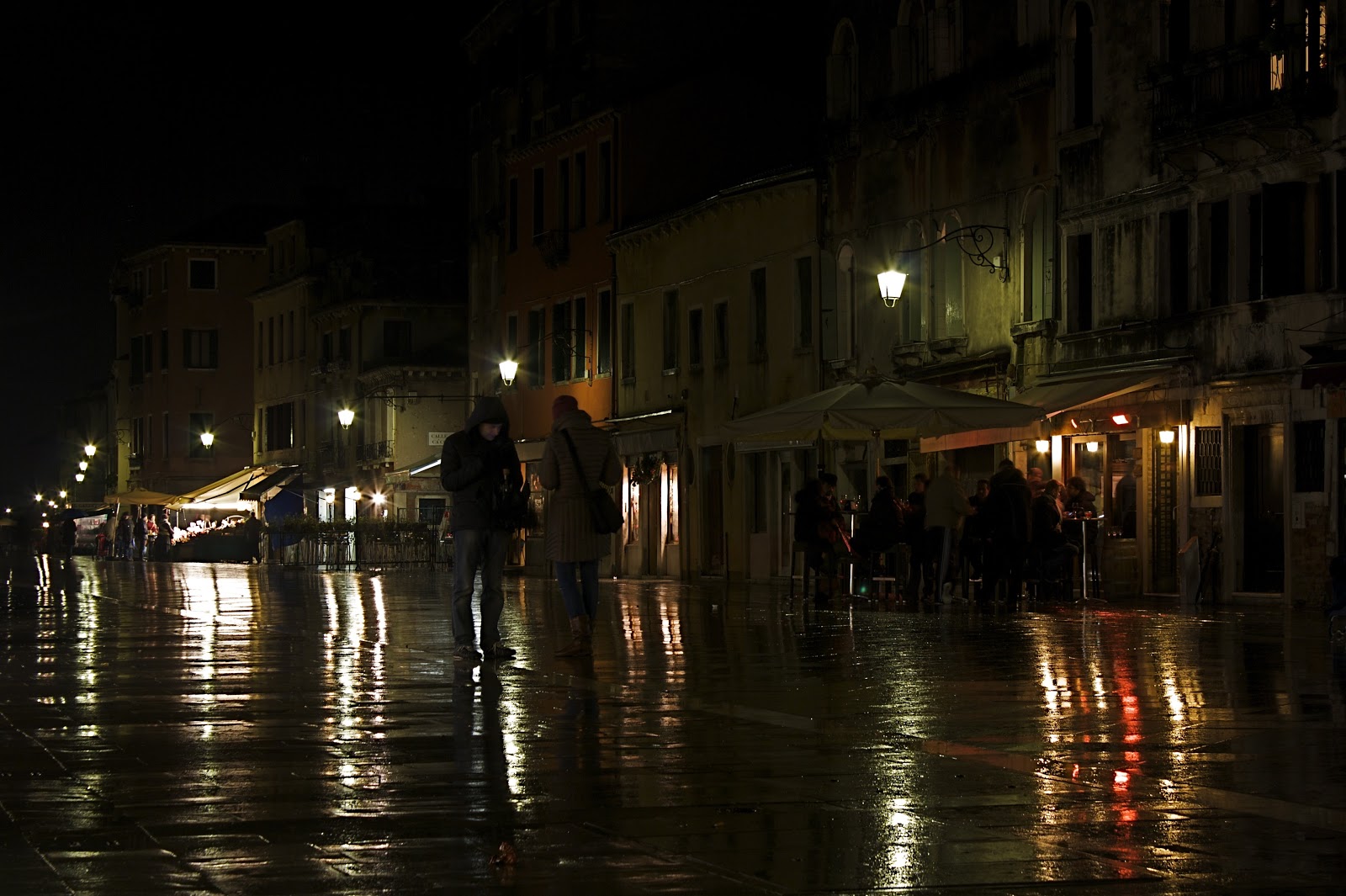
Looking Ahead & Looking Back on a Wet Via Garibaldi, This Evening

Each member of the couple at center tends to his or her own texting while the patrons of the bar at right socialize the old-fashioned way
Felice anno nuovo a tutti!

One of the best times of the year now arrives in Venice: that blessed lull between the immediate past, when tourist hordes invaded the town for New Years Eve, and the all-too-near future when tourist hordes will invade it for Carnevale.

After the excitement of the holidays has passed, January can loom--at least in northern climes--as a great cold gloomy blank. But not for this inhabitant of Venice. Any inclination of my own to slip into a winter funk vanished today when I realized that the city is entering the closest thing it has to an "off-season".

It's hard to believe now that 50 years ago, when Jan Morris was writing her famous book on Venice, the tourist season lasted just four months.

Morris writes that gondolieri put away their oars for the long winter and worked other jobs.

Now, of course, gondolieri ply the canals year-round. Except for the month--either in January before Carnevale, or February, right after it--that many of them close up their houses and escape to Thailand for an extended holiday. Phuket is typically their destination. Though the wife of one gondoliere complained to me last year, after returning from four weeks there, that the place was now on the verge of being ruined. The inexpensive exotic paradise she and her husband once knew has become as pricey, she said, as any other run-of-the-mill resort area, and the sound of Italian is as common on the beach there as on Via Garibaldi. Or, well, almost...

But that's a worry for the gondolieri and their families right now, not me, who's thrilled at the prospect of hearing Italian, and only Italian--rather than English or German or French or Russian--filling the air of Via Garibaldi. 

Saturday, December 29, 2012

Dangerous Elegance at La Fenice, Tonight


It's generally agreed that the most elegant way of arriving for a performance at La Fenice is by the water entrance at the back. But with tonight's extremely low tide--that left the theater's wood pier beyond the reach of any boat and the slimiest and most slippery of its steps exposed--it became easily the most hazardous.

Which I suspect makes La Fenice the only opera house in the world where a familiarity with the evening's tidal chart is at least as important as a familiarity with the night's libretto.

Friday, December 28, 2012

Pagans, Paduans, Soviets & "The Most Beautiful Painting in Venice"

"The Abduction of Persephone," Roman sarcophagus, 1st Century: Museo Correr
As we approach the year's end I hope I'll be forgiven for returning to a post I originally intended to put up at the beginning of November, shortly after my 31 October post on "The Most Beautiful Painting in Venice" (http://veneziablog.blogspot.it/2012/10/the-most-beautiful-painting-in-venice.html).

The painting I referred to in the title of that post was done by the obscure Antonio da Negroponte in the middle of the 15th Century and hangs in the shadows near a side door of the church of San Francesco della Vigna in Castello.

It's the only known painting by Antonio da Negroponte, but as a loyal reader of this blog, Sasha, very helpfully shows, it's not the only known painting of what is called the Paduan school. He provides a number of other striking examples of this same theme as painted by others (such as Carlo Crivelli) associated with this school here:

http://sashha.livejournal.com/969301.html

Images of fruitfulness (and literal fruit) appear in virtually all of the examples Sasha presents, but none in such abundance as in Antonio da Negroponte's. The fecundity of da Negroponte's painting is one of the things I like most about it: that orchard in the background, the flowers all around, the wreath of fruit arching over Mary's throne. It's the most bountiful setting for the Virgin and Child enthroned of any I can recall seeing in Venice.

I think it was this abundance that inspired my wife Jen to remark in passing that there was something a little pagan about the work, and that the hovering presence of The Big Guy and the Holy Spirit added later and by other hands to the original work by Antonio da Negroponte was an attempt to bring this particular Mary back to her proper place within Catholic doctrine. To keep her from tilting a bit too much toward Demeter, the Greek goddess of (among other things) the harvest, whose presence one senses beneath the cult of Mary in Sicily, for example. 

Perhaps because I like thinking about Antonio da Negroponte's painting in these terms--and because what we find in art is often what we're looking for--it's probably no surprise that a couple of days later I came upon a similar depiction of fruitfulness in the Museo Correr (pictured at top). The fruit in this case, spilling from a two horns o' plenty, festoon the side of a 1st-century Roman sarcophagus. And depicted above the fruit is the abduction of Demeter's daughter, Persephone, by the god of the underworld, Hades.

This abduction of her beloved daughter sent Demeter into such a funk that the crops over which she had control withered and died. Demeter would eventually get her daughter back, but only for part of the year. And those months of each year that Demeter's daughter was condemned to spend with the god of the underworld were the unfruitful seasons of the ancient Greek (then Roman) calendar, while her daughter's return from the underworld coincided with spring.

In other words, like the story of Mary and her son, the story of Demeter and her daughter is one of death and the promise of rebirth--of a heavenly sort, in the former case, of a cyclical natural order in the latter.

Which made me think of another work in the church of San Francesco della Vigna, and another work I posted a photo of in early November. Not the Antonio da Negroponte altar piece, but the Sagredo family chapel, which, as you can see in the detail at right, is adorned with monochromatic wreaths of plaster fruit, much like the grapes, apples or pears that appear in marble upon the Roman sarcophagus. But in the Sagredo family Chapel, which is also, after all, the family mausoleum, the wreaths also contain pomegranates, bursting open in their ripeness to show the seeds eaten by Perspehone; each one of which (six in all) would doom her to another month spent each year in the underworld.

So there you have how The Most Beautiful Painting in Venice is linked forever in my mind with both Paduans and pagans--as well as how the Sagredo family chapel is linked to a Roman sarcophagus in the Correr.

But where, you may ask, do the Soviets come in? The answer to that takes us back to the always informative Sasha, who noted in a comment when I first posted the above photo of the Sagredo family chapel (6 November) that:
Such pieces were an inspiration for the masters of Stalin's Barocco - in the years of scarcity they molded plaster very skillfully into cornucopie overflowing with fruit, a lot of public spaces of the period were - and some still are - decorated with the images of excess.

Totalitarian art is supposed to be more restrained and heroic, mounds of Earth's bounty gave the Stalin's Barocco a feel of a more epicurean Utopia.
 Alas, Stalin's Baroque ultimately had more to do with doom than with bounty.

Sunday, December 23, 2012

Buying a Christmas Tree in Venice

The boy rode the scooter to school, the Christmas tree rode it home
"We need a mototopo," was the first thing Sandro said after agreeing that we should buy a Christmas tree on our way home from his school last week. A mototopo is one of the very long work boats you see carrying pallets of groceries, or a mountain of bulging hotel laundry bags, or wheel barrows, cement and other construction materials around the city.

Sandro has become very Venetian in that he truly, fervently believes that everything one needs to do should be done in one's own boat, and that for every job or even errand there is an appropriate boat.

I told him that a small outboard motor boat would be plenty big enough for the size of tree we could fit into our living room, but he brushed this off. I was missing the point. He announced: "Nonno Pietro (the grandfather of his friend) would use a mototopo."

"But he has a trasporti business," I replied. "We don't even have a small boat of our own."

Which, blatantly true though it is, was still the wrong thing to say.

"Ahhhh," he began, slipping into the whiney pleading reserved by other kids in other locales for kittens or puppies or bunnies, "when are we going to get a boat? We need a boat..."

I assured him the vaporetto would work perfectly well for the tree we were going to buy. Again he looked at me like I was clearly, stupidly missing the point, but I cut him off before he could get started again: "Talk to your mother about it," I told him, "okay? We just need to get a tree today."


There aren't really many places to buy a Christmas tree in Venice. Florist shops often stock a couple, and that's where we bought a tree--actually, a prickly little evergreen bush--the first Christmas we were here.

There's a large tree lot set up for the season on the edge of a park on Via Sandro Gallo on Lido--and that's where we bought our tree last year.

And there's the well-known seasonal lot beside the Church of San Felice on Strada Nova where we bought our tree this year.

Coming from New York, where fresh tree lots crowd the sidewalks all over the city, I was initially surprised that there were so few places to buy trees here. But the fact is, while practically every Venetian we know has a tree (some have two), they are all artificial. There's probably some cultural significance in the contrasting preferences of Venetians for artificial trees and most New Yorkers for real ones, but I'll leave that as a subject of rumination for someone else. It's the holiday season, there's too much else to be done.

I wonder if at some point Sandro himself, influenced by the traditions of his classmates and friends, will himself suggest that we buy an artificial tree.

In any case, lacking not only a mototopo but even the humblest of personal boats, we transported our tree con radici (with roots; that is, potted) on Sandro's scooter to the vaporetto stop at Ca' d'Oro, and on the vaporetto home.

To my great relief, we were early enough in the afternoon that the vaporetto was not crowded, and Sandro was so excited to have the tree--though it may not have been exactly the right type by most Venetians' standards--that he didn't complain about the totally inappropriate manner in which we were transporting it home.

I considered this an early gift.


Saturday, December 22, 2012

Fog City: 2 Photos Just Taken (1:30 pm) off the S. Zaccaria Stop


In case you're wondering what it's like in Venice this afternoon, my answer would be sublimely foggy. And here are two photos fresh off the memory card as evidence.

La Dogana is barely there, but Giudecca has disappeared completely