Sunday, January 31, 2016

Carried Away: Festa delle Marie

Half of the contingent of Marias carried down Via Garibaldi
The usual quiet of the riposo period along Via Garibaldi, when all its shops are typically shut up, was broken yesterday by the procession of the 12 Marias (or La Festa delle Marie), passing through from its starting point on the island of San Pietro di Castello and headed (via the Riva) for Piazza San Marco, where the newly-finished Carnevale stage and a large crowd awaited.

The celebration's origins are usually placed more than 1,000 years ago, in 943, and involve pirates, lovely brides, kidnapping, treasure, and a heroic pursuit by the wronged Venetians, led by their fearless doge. A succinct account of the feast's history can be found in English and Italian here: http://ombra.net/tradizione/marie.htm#ENG. A more extensive illustrated account of both the past and present versions is available in Italian here: http://www.festadellemarie.it/FestadelleMarie.it/Festa_delle_Marie.html. A more extensive historical overview in English is here: http://www.monicacesarato.com/blog/2011/01/24/festa-delle-marie-venice-carnival/.

I had the luxury and pleasure yesterday of working with another photographer, my eight-year-old son, Sandro, and give photo credit where needed. 

photo credit: Sandro Varni


photo credit: Sandro Varni

Thursday, January 28, 2016

Double Vision in Piazza San Marco: The Build-Up to Carnevale


Watching the workmen in Piazza San Marco late yesterday afternoon hurrying to complete the large stage and its extensions before the activities of Carnevale begin in earnest this weekend I found myself feeling sorry for any designer charged with the task of devising a set of magical temporary structures in what has long been one of the most fantastic squares in Europe. Even the most whimsical vision realized in lumber has no hope of ever competing with just the basilica of San Marco alone, its eccentricities and excesses and exoticism. It's that strange instance in which something especially constructed for a holiday can't help but be rather dull compared to the same old structure you see everyday.

Monday, January 25, 2016

Carnevale Opens with a Venetian Air


Most Venetians I know don't get too excited about Carnevale, unless they're young children, the parents of young children (to a somewhat lesser degree), or business people who profit from the crowds (to a calculating degree). The absence of much Venetian involvement in the festivities is why Piazza San Marco can sometimes feel more like a convention center to me during Carnevale than a festive civic center or the "grandest drawing room in Europe." The Venetian spirit of Carnevale is usually found in these weeks on calli or in campi or patronati (parish halls beside the churches) away from the Piazza.

At least after the opening weekend, that is. For the opening weekend, which just took place yesterday and the day before, can still bring out adult Venetians--to the floating entertainment on the Canareggio Canal that took place Saturday night, and to yesterday's Corteo Acqueo down the Grand Canal organized by the association of rowing clubs in the lagoon.

This is the best--perhaps only--time to see adult Venetians in costume, and one of the very rare times during the year you can hear actual Venetian songs being sung on the Grand Canal (instead of the ubiquitous "Volare" whose originator, Domenico Modugno, was born in Bari). In fact, the trio of musicians in red-and-white striped shirts above were singing a song I'd heard of before, but never actually heard sung in its entirety:

Scarpe e calseti
Piatti e pironi
Porte e balconi
Che sá da freschin.

So nato a Venessia
So fio de pescaor
Par quindese giorni 
Se magna el saor.

Shoes and socks
Dishes and forks
Doors and balconies
They all smell of fish.

I'm a native Venetian
The son of a fisherman
For fifteen days
We eat el saor.

(The story of where I first learned about this song is here: http://veneziablog.blogspot.it/2012/07/venetian-fishermans-lullaby.html. If you find yourself on a gondola ride anytime soon that includes a singer as part of the package you might ask if he--it's always a he--knows the el saor [a sardine dish] song.)

In any case, the corteo began at the Punta della Dogana and made its way down the Grand Canal to the Canareggio Canal, where typical Venetian dishes were promised along its banks. I didn't go there myself, but, according to the local papers, some 70,000 other folks did. Or 15,000 more people than currently reside in Venice. If only that many people still lived here! 


The passengers on the number 1 vaporetto above found themselves held up at the San Tomà stop while the parade passed--but in exchange for the delay they received a great view of the proceedings

Saturday, January 23, 2016

Designs for Living: Vivienne Westwood and We Are Here Venice

Originally posted on this blog in February 2014, this is one of the images used on the Westwood site
At the end of my last post I referred to people here in Venice who believe the city would serve well as a model in which to study problems (and possible solutions) that affect the world beyond this lagoon; that this very old city might, in fact, be a perfect laboratory for a good number of very contemporary dilemmas.

One of these people is Jane da Mosto, one of the authors of The Venice Report (Cambridge University Press, 2009), whose subtitle lays out a number of the issues facing not only Venice, but other cities around the world: Demography, Tourism, Financing and Change of Use of Buildings.

What isn't specifically mentioned in the subtitle is climate change and rising ocean levels--though perhaps it goes without saying that a city so intimately linked to the sea, so very long dependent upon a knowledge of tides and so completely subject to their effects, might have some important contributions to make to our knowledge in that area.

Long a student of the lagoon (she is also the co-author, with Caroline Fletcher, of The Science of Saving Venice), and long active in the community, she's just started to put online a new website for her latest project, We Are Here Venice: an advocacy group for responsible and sustainable use and development of the Venetian lagoon and its resources: http://www.weareherevenice.org/.

In calling attention not only to the problems of the lagoon city, but to a problem-solving approach grounded in both the latest science on this unique ecosystem and a commitment to Venice as a living city of residents (rather than a mere theme-park stop on the itineraries of cruise ship and bus lines), she's just received the support of the designer Vivienne Westwood. Westwood--a rare designer who actually encourages people to buy less--featured Venice and We Are Here Venice at her menswear show last weekend in Milan and, now, does so on her blog: http://www.viviennewestwood.com/blog/venice-venetians-venice-world.
 
I was happy to contribute images to each site that I'd previously posted here on this blog.

The short piece above on the Westwood blog supplied by We Are Here Venice succinctly lays out the issues and the group's approach. But I hope in the not-too-distant future that I might check-in with Jane da Mosto at greater length about her thoughts on the current state of Venice. If you have specific questions about the city you might like me to ask, please leave them in the comment section below.

Tuesday, January 19, 2016

Venice, Model City

Detail of a small-scale model of Venice, each building made by a different student in Sandro's second grade class

Last fall our son Sandro proudly returned home from school with drawings of different style Venetian windows he'd made during a giretto (or "little walk") with his second grade class. This was a surprise for a couple of reasons: (1) because it hasn't been that long since he disliked having to do any kind of drawing in school and (2) because it also doesn't seem too long ago that, upon moving here, he proclaimed--repeatedly--how much he hated the way Venice looked. It was, he insisted each time we stepped outside our door that first November five years ago, yucky, ugly, and too old! (http://veneziablog.blogspot.it/2011/01/i-dont-like-venice.html)

Now he can't imagine ever leaving it. Though whether that's because the city's famed beauty has engraved itself upon his soul, as upon so many other souls over the centuries, is uncertain. For when asked by visitors what he likes best about living here, his answer is always the same: the fact that he can drive boats here, sometimes even large work boats (mototopi). Whereas every other place we might live, on land where people travel in cars, he'd have to wait until he was sixteen to be able to tool around town. 

Sandro's first effort at cataloging some of Venice's windows
In any case, he and his second grade classmates are now being asked to look at the world immediately around them in a methodical manner and to reproduce it on paper. This is something that some kids take to more readily than others, and the varying alacrity with which kids do this has made me realize how big a jump it actually is to go from the real, experienced three-dimensional world to a two-dimensional system of representing of it: whether that system involves a conventional repertoire of shapes (such as the triangle above a square that commonly represents a house in kids' drawings) or the alphabet.

I could imagine a fable in which the beauty of a city was such that its inhabitants refused to develop or use any system of two-dimensional representation, neither art nor writing, as traditionally it's said that both of those systems of representation are predicated upon, or inspired by, the absence of the thing represented. The prehistoric animal shapes on some cave wall were created to represent animals not there, just as the first mythical artist, we are told, was inspired by the absence of his or her beloved to paint the world's first rudimentary portrait. The residents of the city in my fable would refuse to denigrate the marvels of their beautiful home by representing them, by ever conceiving of them as anything other than fully, abundantly present all around them.

But that's a topic for another post.
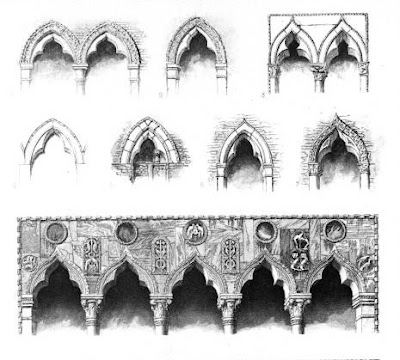
A small sample of John Ruskin's catalog of Venetian arches
Sandro's simple drawings of arches and the like in his school notebook actually made me think of John Ruskin's beautiful renderings of Venice's various styles of arch. All of Ruskin's painstaking depictions of Venice's architecture were--like the effort of the mythical first artist mentioned above--also inspired by absence and loss. But in Ruskin's case his beloved city of Venice--for which he evinced a passion notably lacking for his vivacious wife--was not yet gone but going, and quickly, he believed. Disintegrating like a sugar cube in hot tea, he said (resorting to an admirably English simile).

While Lord Byron, and visitors like him, had derived a gratifying melancholy from the city's deliquescence and seemingly inevitable collapse, Ruskin sounded an international alarm, warning the world of what it was about to lose.

And his alarm has continued to echo--quite softly at some periods, very loudly at others--pretty much ever since.

Though John Julius Norwich has reminded us that Venice, for all its serious current problems, is still in far better shape than it was at Ruskin's time, how many visitors to it can't help but think of it as a sinking city, a dying city? Even a dead city--or merely a museum? Or as the toothless old Queen of the Adriatic, bedridden and always a bit more crass and desperate and maybe even hopeless, but still working whatever she's got left for all it's worth? You know the images, the constant undercurrents...

I've actually met visitors to the city who were amazed to find out that things like elementary schools still exist at all in Venice!

Sandro's drawings of arches, however, turned all of this upside down for me. They weren't mournful or melancholy images of a world's end, souvenirs of something disappearing, or symbols of some imminent cultural or environmental collapse, but of a world's beginnings.

They are, quite literally, the starting points for his second grade class on their journey out into the broader world. 

Detail of a large poster made by Sandro's class
For the teachers of his public school class--the same group of teachers that will remain with his class for each of its elementary school years (from grade 1 through 5)--have been following an educational course that began with the immediate and physical and experiential and is headed toward the more more far-reaching and abstract.

So that last year in first grade, for example, the class began to think about and represent how they live not just on paper with drawings, but by constructing a model of a house that was actually large enough for them to go inside. When it comes to minimizing the leap between actual experience and its conscious representation, that's about as small as you can, practically-speaking, make it. (Short of representing one's own house or school by building an exact scale replica of it.)

This year the students are well into reading and writing, and out in the world around them, sketching what they have seen from their earliest years but probably rarely ever tried to represent in a conscious way.

Of course what's nice about representing things in two-dimensions (or in small models) is that it not only gives you a way to record what you see, to re-present it as best you can, but also to manipulate and re-imagine those things in a way that's not so easy to do with the things themselves. The distance between the system of representation and the thing itself represented is not, in other words, only an indication of some loss or absence but of possibility: it is the space of conceptualization, of thought, of imagination, and, potentially, of creation and change.

In Sandro's case it marks a third stage in his relationship with the city of Venice. His initial emphatic rejection of its alien otherness was followed by an even stronger and more complete immersion in it. For Venice, with its absence of cars, is a uniquely hospitable urban space for children, offering even the youngest of them the chance to run free as kings and queens of its calli and campi (see, for example, http://veneziablog.blogspot.it/2012/03/wild-in-streets-or-calli.html).

Now, with his class, through writing and drawing, he's begun the process of learning of the city as not just given and lived in and immediate, but as something that can be regarded from a certain distance, as an object of thought. Learning about the city and its past becomes for them a model for learning about the broader world and a past beyond one's own personal past.  

It's an amazing process to watch and participate in, this one of education, and immensely under-appreciated it seems to me in the two countries of which I'm a citizen, America and Italy, except as a means to a career, to money-making. It can, of course, be that--though not always, as more and more college graduates in both countries are discovering. But more essentially it is a process of awakening that's perhaps even more striking when it takes place in a city often said to be "dead," like Venice.
 
Moreover, there are people here who argue that this process of taking Venice as a model from which to start thinking about the larger world (and, specifically, many of its most serious challenges, such as climate change) could prove beneficial to more than just local students. But that, too, is a topic for another post. 

Tuesday, January 12, 2016

Holiday Traffic

A resident in a sandolo pauses at an intersection of canals in the historic center to let tourist traffic pass

Here's a selection of figures reported by local newspapers in the first 10 days of this new year:

1) A representative of Venice's hotel says that the number of visitors in town for New Year's Eve and the Feast of the Epiphany (6 January) was nearly double that of last year.

2) Attendance at the 2015 Venice Biennale totaled more than 500,000: a 5.45% increase over the 2103 Biennale.

3) Figures for the first 8 months of 2015 show that on average five stores close every week in the greater Venice area (including Mestre), while half that number of new ones open. The figures are actually worse on the mainland than for Venice proper, but in the historical center the type of stores most often lost are the traditional smaller markets (delis, fruit and vegetable dealers, as well as things like hardware and ordinary clothing and shoe stores--as opposed to designer flagship boutiques), which are hit hard by the combination of a dwindling local population and newly opened supermarkets.

4) The number of residents in Venice is now estimated to have dropped below 55,000. When it dropped below 60,000 in 2009 mock funerals were held for the city. What should be done now?

In other words, the traffic in (or passing through) Venice continues to increase, while local life just as continuously decreases. Tourist traffic and cruise ship traffic have hugely increased in the last 15 years. This, according to ruling business interests, was the only way to keep the city alive. And yet actual residential life continues to dwindle. Big business interests have profited, Venetians have vanished from the city, and this, we are told, is development.

And, indeed, we are promised even more of it!

(Though, in fact, I believe that the usual name applied to reckless, unbounded development that first debilitates then kills its host is cancer.)

None of which I really planned to go into today, but the scene above that I saw and photographed just before the New Year struck me not just as picturesque but somewhat emblematic of the crossroads at which Venice is stalled.

But not only Venice. One of the uncomfortable facts here is that more than a few residents who lament the closure of one or another neighborhood store are the very same ones who go to the mainland or online to buy, say, a computer printer rather than pay perhaps very slightly more to some neighborhood shop. Or who do all their shopping at a chain supermarket rather than "bother with" a fruit and vegetable stall, a butcher, a bakery, etc.

In most of America (and elsewhere)--including now, alas, even New York City--shopping in large chains and online is the homogeneous norm. When you come to Venice, therefore, stay over a night or two (or more) and take the opportunity, while it lasts, to shop in local markets.