Wednesday, November 27, 2013
Baby, It's Cold Outside: Riva degli Schiavoni & the Dolomites This Morning
Especially for those piloting a mototopo without so much as a wind screen, much less a cabin.
I notice such things often these days, as Sandro not only persists in his plans to buy a mototopo when he turns 18 in a dozen years, but has even decided upon a name for the trasporti business he plans to start, as well as the color scheme for his fleet of boats. His play now centers around the creation of elaborate transportation networks--not only on water, but on land as well.
Well, there are certainly much worse ways to make a living than plying the lagoon like the grandfather and uncle of one of Sandro's closest friends--though, of course, such work too is largely tied into the city's tourist industry.
Saturday, November 23, 2013
Festa della Madonna della Salute--and Castradina
Glancing at the Città di Venezia website just before the Festa della Madonna della Salute last Thursday I'm pretty sure my eyes swept across a phrase describing it as the least turistico of the city's holidays. This is the kind of thing I should have double-checked, but if it were there it was the last thing I wanted to know: as the most alluring marketing line one can use about anything here is that it is "the least touristic." Few phrases draw a crowd of tourists more quickly, so I'll restrain myself from mentioning any such thing about the festa and settle instead for saying that it is the only large holiday event in the city where one can conceivably hear only Italian being spoken--and that alone is worth celebrating. While it lasts.
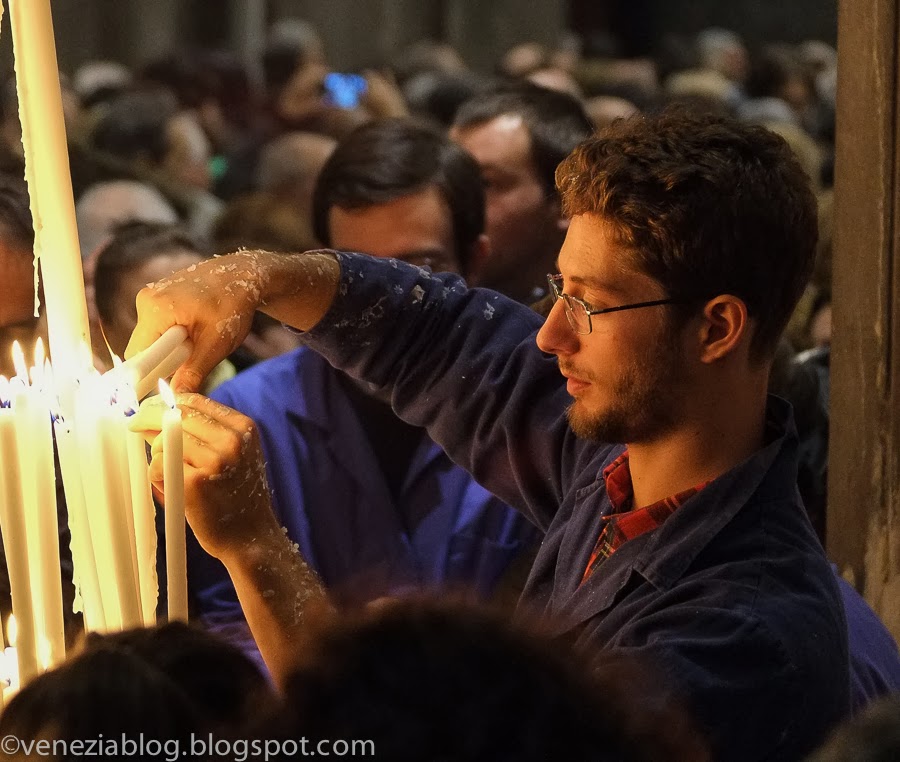
By the time we arrived at 4 pm the church and the calle of balloons and sweets (known on every other day of the year as the Calle dei Cathecumeni) were packed. Judging by all the pushing inside the church, the Festa della Salute is not one of those holidays that puts believers into a retiring, contemplative, tread-softly-on-Mother-Earth-and-one's-neighbor's-toes kind of mood. But then again, I've been shoved much more forcefully by elderly ladies anxious to board a vaporetto so, relatively speaking, the crowd of people surging forward to have their candle(s) lit as a sign of gratitude to the Virgin for delivering the city from the plague of 1630-31, and as a little nudge for Her to keep them well for the upcoming year, wasn't so bad.
In fact, the one spot in the church where some people did turn their thoughts to Mother Earth (or at least their eyes to the ground), around a small metal disc set into the marble floor, was a small aperture of calm amid the kaleidoscopic shifting all around. There I did as Tiziano Scarpa suggests in a passage of his book Venice Is a Fish (which I've only just gotten, not yet read, and only fortuitously happened upon the morning of the feast):
On the feast of the Madonna della Salute place yourself at the exact center of the octagonal church, beneath the lead chandelier that plunges tens of meters from the dome; drag the sole of your foot across the bronze disc set into the floor, as tradition decrees, touch with the tip of your shoe the words unde origo inde salus cast into the metal: from the origin comes salvation, the origin is the earth, walking on it brings you luck, does you good; salvation rises up from the feet.This may be a tradition, but not one that is widely followed. There were only two or three people at a time politely awaiting their turn to stand directly upon the metal disc, upon the belly button of the church, the sacred omphalos. Everyone else had their minds on candles.
By the time I took my turn on the bronze disc, Sandro had forced Jen to take him outside to the calle of balloons and sweets--he'd had his mind on nothing else since I picked him up from school.
As 6 pm approached the wind became biting and rain began to fall, as it seems it must on this day--at least each of the three times we've celebrated it. It wasn't a bad thing, as waiting at home to warm us up this year was the castradina whose preparation I wrote about in my last post.
Some people, our neighborhood butcher revealed to Jen only yesterday, don't like the traditional dish of smoked seasoned sun-dried leg of mutton called castradina upon first bite; others come to dislike it after 2 or 3 days of its taste revisiting them due to gastric upset. According to our butcher, the shorter the preparation time, the longer (or more likely) the unpleasant after-experience. The two batches of carrots, onion and celery that one boils the meat with two different times (according to the recipe in my previous post) are present not to flavor the broth but to absorb some of the fat from the very fatty meat. That's why they're thrown out after being cooked--and why the first pot of boiled water is also thrown out--rather than kept as part of the final soup. Even if all goes well, our butcher admitted yesterday, castradina is not something you should eat more than once a year (troppo pesante, she said, too heavy). She asked Jen if she'd recommended the right amount of meat for us to buy and looked, first, happy, when Jen said it was just right, then slightly disgusted upon hearing that there was just enough of it for me to have it for lunch the day after the Festa.
Of course our butchers didn't dwell upon the digestive dangers of castradina as they told me how to prepare it, only advised me to follow the recipe carefully. And having done so, it was not at all pesante. Sandro didn't like it as soup--I think the verza (savoy cabbage) put him off--but he loved the meat once it had been removed from the broth. Jen liked the soup a lot, as did I. I'm no "foodie", nor a food writer, so I can only say I was surprised by the sweetness of the verza, like faint glimmers of Tiepolo's pale pinkish yellow in the dark smoky atmosphere of the mutton. You see, even in the finished soup I still tasted somehow the spiced smokiness of church incense I'd smelled in the castradina before cooking--something which sounds entirely unappetizing to anyone else (such as Jen), but which seems appropriately sacramental to me in a dish eaten only once a year and three days in the making.
For more on castradina and how one goes about preparing it, see: http://veneziablog.blogspot.it/2013/11/a-ritual-dish-for-la-festa-della.html
Wednesday, November 20, 2013
A Ritual Dish for La Festa della Madonna della Salute, Long in the Making
![]() |
| Two bunches of castradine |
You see I'm making castradina, the traditional Venetian dish eaten for the Festa della Madonna della Salute on November 21, and it's a three-day process to prepare it. Or I should say that it's a three-day process according to the definitive recipe dictated to me by our trustworthy neighborhood butchers who have never yet, if you'll pardon the expression, given us a bum steer (as they say in America).
Of course this being Italy, there's no lack of other equally "definitive" recipes for castradina, some suggesting you can be done with the whole thing in a single day, or even a couple of hours. According to our butchers, restaurants often use a truncated version of the preparation process with results that are schifoso--disgusting, and prone to a certain gelatinous quality. I'm doing my best to avoid producing anything schifoso.
![]() |
| A castradina displayed on greens in our neighborhood butcher shop |
A handwritten sign alerting customers that our husband and wife pair of butchers were now accepting orders for castradina appeared in our nearby macelleria in early November, but I really thought nothing of it until last week when two castradine took up their places--looking rather like sculptural objects--in the center of the butcher case.
Actually, what they resembled were ritual objects that in recent years have been displayed in museums and gallery shows as sculptural objects: the African power objects known as a boliw (or boli, if there's only one). These abstracted buffalo-shaped figures are in the words of the Rand African Art website, "complex creations created from esoteric recipes." Rather like the castradina themselves.
![]() |
| The inedible ritual object known as a boli from Mali |
They could tell us that our castradina was produced during the month of July in the most impressive and traditional cantina they've seen, and that they think the older man who did so makes the best-tasting castradina of any they've tried.
Now, the boli are definitely not made to be eaten, built up as they are of various animal and vegetable matter, mud and clay, and coated as they are with successive layers of ritualistic materials such as animal blood, millet porridge, alcohol and chewed kola nuts. Rather it was the abstracted shape of the castradina that made me think of them, and the castradina's dense surface layer built up over time in a series of secret steps and composed of mysterious substances.
And I'd hate to think what a boli might smell like if one put one's nose up to it... Our castradina smelled to me more woodsy than simply smoky; more gamey, somehow, than meaty--redolent more of pheasant, say, than salami. It smelled kind of nice--but not necessarily like food. It reminded me, in fact, of the incense I remembered from the Catholic funeral masses I served as an altar boy, and that I sometimes still catch a fugitive drift of in churches here.
![]() |
| Sliced castradina ready to be put into the pot |
Can't I just put it in the fridge overnight? I asked.
No, I was told, they didn't have refrigerators when this dish was developed.
This evening I brought the pot inside, spooned the fat off the surface of the water and disposed of it, took out the pieces of meat, then threw out the water and vegetables. Then I once more put the meat into the pot, added a cut up carrot, stick of celery, and onion, covered them all with water and set it to boil for an hour.
When it's done, I'll once more close up the pot and place it outside.
Then tomorrow evening, I'll bring the pot in, and once more skim the fat off the surface of the water and throw out all vegetables. I'll take the meat out of the broth, set it aside, then filter the broth.
I'll then separate the meat from the bones using my hands--NOT a knife, they emphasized--and throw away the bones.
Then I'll slice verza--ie, savoy cabbage--very thinly, and an onion very thinly. These vegetables I'll put into the broth with the meat and cook for 30-40 minutes.
I believe olive oil also comes into play tomorrow, but I need to stop by the macelleria and ask them about it. They dictated the recipe to me in Italian, I was writing it in English--by the time we reached the final steps I figured I could come back and ask about the olive oil.
I have no idea how this will turn out; how it will work out as a recipe. But as a community-building ritual I can imagine few things more effective. When I went to buy the required vegetables yesterday, I had only to mention the verza, or cabbage, to the green grocer on Via Garibaldi for him to list the rest of the things I'd need. Beside me I heard a woman asking for the same ingredients. For a brief moment we all seemed to be on the same page in the long history of Venice.
Sunday, November 17, 2013
Estate di San Martino on the Grand Canal
![]() |
| Catching a ride home from school during the official Estate di San Martino |
The feast of San Martino is November 11, and if you're not familiar with how it's celebrated in Venice you can find some images of this year's activity here: http://alloggibarbaria.blogspot.it/2013/11/festa-san-martino-2013.html#more, or, from a previous year, here: http://veneziablog.blogspot.it/2011/11/what-racket-festa-di-san-martino.html
But this year the 3-day strike of taxi and transport drivers seemed to create (at least metaphorically) a second specifically aquatic Estate di San Martino on the Grand Canal. In the absence of the usual heavy traffic, the Grand Canal seemed to be infused with a soft glowing tranquility--even in the gloom and rain of the third day of the strike last Friday. And the main reason this unusual calm resonated so much with Venetians is that they knew perfectly well that, like Estate di San Martino or Indian summer, it would not and could not last.
In fact, by Saturday morning the strike was over. No concessions were made to strikers, Mayor Orsoni proudly announced, the new rules governing traffic on the Grand Canal would be implemented in full, as planned--though the city would be open to making minor adjustments to them if needed to assure their better functioning.
So Estate di San Martino in both senses is truly over. But we can hope that a bit more calm (and safety) in the Grand Canal is here to stay.
Friday, November 15, 2013
Prayer of the Motoscafista (or Water Taxi Driver)
But while the strike may make some people appreciate the city's dependence on the transport boats that carry goods and supplies to businesses, the strike has also clearly had what local activist Michela Scibilia called a "boomerang" effect on water taxi drivers. Most Venetians seem quite happy to be rid of them, and yesterday morning the mocking "Preghiera del motoscafista" or "Prayer of the Water Taxi Driver" (below) could be found taped up all around the long commercial thoroughfare of Strada Nuova.
Preghiera del motoscafista
Caro e dolce Gesù bambino
Che esaudisci i desideri di ogni piccino
Ascolata la nostra accorata preghiera:
Riaprici il Canal Grande de mattina a sera!
Che it limiti salgano a dieci e poi a venti
Per farci sfrecciare felici e contenti
Che Battelli e Lancioni affondino tutti:
"Il Canal xe nostro, brutti farabutti!"
Se poi ti avanza qualcosa da fareMy quick rough translation:
Le carte di credito aiuta a bruciare.
Sia mai che salga il fatturato
E qualcosa finisca, Buon Dio, dichiarato.
Aiutaci infine coi veneziani
Non ci capiscono, son disumani.
I nostri prezzi non voglion pagare
Col trasporto di linea si ostinan a viaggiare.
Il gasolio costa, i nostri vizi pure
Le nostre condizioni di vita son sempre più dure.
E purtroppo accade che anche quaggiù
Ci sian motoscafisti poveri come Gesù.
Dear sweet baby JesusI imagine the taxi drivers were probably hoping for a little more public support, or at least less outright hostility, than the above satire evinces.
Who grants the wishes of every little child
Hear our sorrowful prayer:
Re-open the Grand Canal from morning to night!
Raise the speed limit to ten and then to twenty,
So we can race about happy and content,
And sink every one of the vaporetti and tour boats:
"The canal is ours, you ugly soundrels!"
The next thing you could do
Is help to burn all credit cards
So receipts would never be a problem
And declared income, Good God, would be finished.
Help us finally with the Venetians,
Who don't understand us, and are cruel.
They don't want to pay our prices
And insist on taking vaporetti.
Gasoline costs a lot, as do our vices,
Our quality of life becomes ever more hard,
And unfortunately what's happening down here
Is that we taxi drivers are becoming as poor as Jesus.
Wednesday, November 13, 2013
Venetians to Striking Taxi Drivers Today: "Don't Hurry Back!"
![]() |
| An extremely rare sight: the whole length of the Riva with not a single supply or work boat moored alongside it this morning |
The taxi drivers and mototopi drivers went on strike to protest the new 26-point plan of the city to increase water safety on the Grand Canal after the death of a German tourist riding in a gondola last August. The striking drivers believe that the new regulations come down particularly hard on them, reducing their freedom of movement on the Grand Canal (you can read the entire plan, in Italian, here: http://nuovavenezia.gelocal.it/cronaca/2013/08/26/news/i-26-punti-del-piano-comunale-1.7638279).
![]() |
| Though a green garbage boat is on the job, the grocery supply boats usually occupying this stretch of the Riva are absent |
![]() |
| The Riva in its entirety belonged to fishermen today |
But I have to tell you, it really didn't. On the contrary, though no one would hope that the supplies to the city might be cut off for an extended period of time, the absence of all those boats tearing or plowing though the city reminded everyone just how beautiful this place can be. It was a reminder of the Venice that existed into the 1960s, the decade during which motorized supply boats finally replaced craft that, until that time, were still rowed, as they had been for centuries. A reminder of the Venice that existed even more recently than that, before the new economy of mass tourism immensely increased not only the number of big ships coming into the lagoon, but the number of work boats required to supply and clean up after tourists, as well as the lancioni granturismi (those large boats that shuttle 50-, 100- or 150-person tourist groups from their tour buses or cruise liners into the city for a few hours then back out). And a reminder, as a Venetian (René Seindal) noted on Facebook, of the primary sources of the damaging moto ondoso: the unrelenting wakes that wear away the city's canals and foundations. (Seindal wrote: "Grazie allo sciopero dei trasportatori ed i tassisti sappiamo ora chi fa la stragrande parte del moto ondoso in canale grande.")
This afternoon Sandro and I caught a ride home from his school in a friend's motorized topa and I can tell you first-hand that the Grand Canal, as well as the small canals all over town, were calmer than I've ever seen them--even on a Sunday or holiday, when, after all, taxis still ply the waters. But you don't need to take my word for it, I attach three short clips from the online version of a local newspaper, La Nuova Venezia (the first one entitled "How Beautiful Venice Is 'Liberated' from Taxis":
http://video.gelocal.it/nuovavenezia/locale/che-bella-venezia-liberata-dai-taxi-privati/20231
http://video.gelocal.it/nuovavenezia/locale/san-marco-e-canal-grande-senza-moto-ondoso/20232
http://video.gelocal.it/nuovavenezia/locale/l-acqua-del-canal-grande-senza-nemmeno-un-onda/20238/20287
So, though I'm not sure whether today's strike will make anyone think twice about the supposed hardships that the city's 26-point safety plan imposes on the drivers of taxis and mototopi, I do think it's reminded more than a few Venetians of the deleterious effects that such craft tend to have on the city itself.
![]() |
| The strike, alas, did not affect the lancioni granturismi, who spewed day-tripper as usual |
Saturday, November 9, 2013
William Dean Howells--and Others--in Palazzo Falier on the Grand Canal
![]() |
| Taking the sun in one of Palazzo Falier's two projecting sun rooms |
![]() |
| A view of one of Palazzo Falier's liatì (and the Grand Canal), as seen from the other |
And what marvelous spaces those two projecting windowed rooms are! I spent a long time admiring them, imagining (erroneously, as it turns out) that Howells had used one to write in. Then a white cat, whom I'd seen out in the back garden when I first arrived, sauntered in and made the more elaborate of the two liatì her own. And as I watched her arrange herself to best enjoy the sun, I realized that for the first time in my life I was seeing the grand hauteur evident in the attitudes of even the mangiest cats in the most humble contexts displayed in a room entirely appropriate to it. Forget about some old achey-backed, bleary-eyed, inky-fingered writer toiling away in a room like this--this room was made for the imperial and luxurious manner of a cat!
![]() |
| The interior of the second sun room |
![]() |
| In this image and the one below: 2 views of Pedro Cabrita Reis's "over-all intervention" in Palazzo Falier |
I'm sure I'll have more to say about Venetian Life after I've read it all, but for the moment I'll just present two of his own descriptions of Palazzo Falier as he knew it:
"We were not in the appartamento signorile--that was above--but we were more snugly quartered on the first story from the ground-floor, commonly used as a winter apartment in the old times. But it had been cut up, and suites of rooms had been broken according to the caprice of successive landlords, till it was not at all palatial any more. The upper stories still retained something of former grandeur, and had acquired with time more than former discomfort. We were not envious of them, for they were humbly let at a price less than we paid: though we could not quite repress a covetous yearning for their arched and carven windows, which we saw sometimes from the canal, above the tops of the garden trees."
"As for our Dalmation friends [a Dalmatian family that lived in the appartamento signorile], we met them and bowed to them a great deal, and we heard them overhead in frequent athletic games, involving the noise as of the maneuvering of cavalry; and as they stood a good deal on their balcony, and looked down upon us on ours, we sometimes enjoyed seeing them admirably foreshortened like figures in a frescoed ceiling."
The complete text of Howell's Venetian Life (along with many other great titles) can be downloaded free-of-charge at the Project Gutenburg website: http://www.gutenberg.org/ebooks/7083
![]() |
| Autumn in the little garden of Palazzo Falier, as seen from the top of the outdoor stairs leading to the first floor |
Yes, as has by now been well-documented, even the most minimal "intervention" in a certain kind of space can radically alter our perception of it. But so can the unexpected appearance of a cat from outdoors. And though it's been a long time since anyone accused me of being a "cat person," yesterday I found myself preferring the cat.
![]() |
| A panorama of the garden of Palazzo Falier |
Subscribe to:
Posts (Atom)